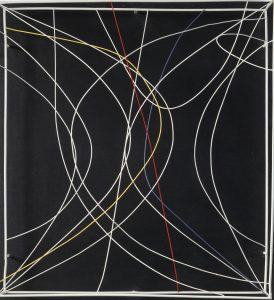
Aleksandar Srnec
Space Modulator, 1953
painted wood
49.5 × 53.6 × 18 cm
MG-4092
Aleksandar Srnec (1924–2010) was a painter, sculptor, graphic artist, and designer. He studied at the Academy of Fine Arts in Zagreb between 1943 and 1949. As a founding member of EXAT 51, Srnec was among the key figures advocating geometric abstraction and the synthesis of art and architecture in Yugoslavia in the early 1950s. After an initial commitment to radical constructivist painting, he soon expanded his practice to encompass spatial experimentation. As early as 1953, he constructed his first mobile and spatial objects. By the mid-1950s, he began exploring kinetic reliefs and sculptural movement, and from 1962 onward he devoted himself to lumino-kinetic research, investigating light as an autonomous artistic medium. Srnec’s trajectory charts a progression from geometric abstraction toward kinetic and light art, placing him among the pioneers of perceptual and programmed art in post-war Central Europe.
Among Srnec’s earliest spatial constructions, Space Modulator marks a definitive departure from the flat picture plane. Housed within a wooden framework, coloured linear elements project outward into actual space, activating the volume rather than enclosing it.
Rather than representing space, the work actively constructs it. Line, colour and void function as equal structural components. In the context of early 1950s Yugoslavia, this work signalled a clear break from figural tradition and aligned Zagreb with contemporary international constructive experimentation.
Text: Marta Radman, curator at the National Museum of Modern Art, Zagreb
Photo: Goran Vranić © National Museum of Modern Art, Zagreb