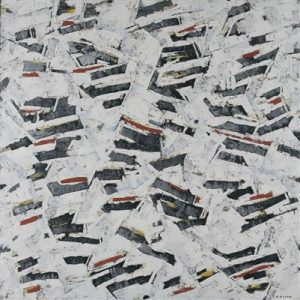
Oton Gliha
Gromače 7, 1966
oil on canvas
138 × 138 cm
MG-2547
The hard, muted stone of Oton Gliha (1914–1999), along with its dynamic precursor—a turbulent painterly lava of linear fissures, freely realized linear elevations, depressions, and chromatic incandescences—transforms, through variations of color, theme, and form, an autochthonous local site—originally marked as the dry-stone walls of Omišalj, Vrbnik, Krk, and Bakar—into a universal, cosmically suggested landscape viewed from an elevated perspective. It is a painting seemingly devoid of gravity; above and below are relativized, while syncopated rhythmic outpourings burst from the surface.
In its most distilled examples (as here, Gromače 7, 1966), the descriptive impulse is sublimated into an entirely new pictorial structure. The factuality of reality becomes the truth of the image. We encounter a new materiality: an unbounded combinatory composition that expands intangibly beyond the given format, as well as a morphology akin to the painter’s own words, sentences, and chapters. Optical forces emerge; we yield to the laws of the pictorial plane and perceive rhythms, directions and counter-directions, growths, parallels, and contractions within a constantly dynamic visual system. The motif is always filtered through the visual and material sieve of representation.
Text: Željko Marciuš, Museum Advisor at the National Museum of Modern Art © National Museum of Modern Art, Zagreb
Photo: Goran Vranić © National Museum of Modern Art, Zagreb