Edo Murtić
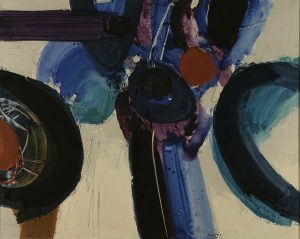
Encounter of Purple, 1965
oil on canvas
130 × 162 cm
MG-2451
Edo Murtić trained with some of the leading artists of his time at academies in Zagreb and Belgrade. Beginning in the 1950s with a reduction of reality through landscapes influenced by lyrical abstraction and Tachism, Murtić developed, in the early 1960s, a distinctive abstract painterly style marked by dynamic gesture and intense color. Through this approach, he became the most influential and widely recognized artist of High Modernism in socialist Yugoslavia, achieving a notable international career.
In the painting Encounter of Purple (1965), Murtić employs broad, graphic strokes to present a vivid example of a coloristically rich confrontation between several fundamental elements of visual order: line and color. The entire visual structure is accelerated through graphic movement. Everything is in tension—stroke, chromatic and achromatic values, the act of painting itself, the ground, and the gesture upon it. Edges and core seem to dance through pronounced chromatic action and diagonal calligraphy, resulting in an expressive symphony. The composition’s strong dramatic quality is emphasized by the counterpoint between bold black strokes and dynamically modulated, condensed blue formations, accompanied by glimmers of reddish tonal accents that spread across the painting’s overall action-driven structure.
Text: Željko Marciuš, Museum Advisor at the National Museum of Modern Art © National Museum of Modern Art, Zagreb
Photo: Goran Vranić © National Museum of Modern Art, Zagreb