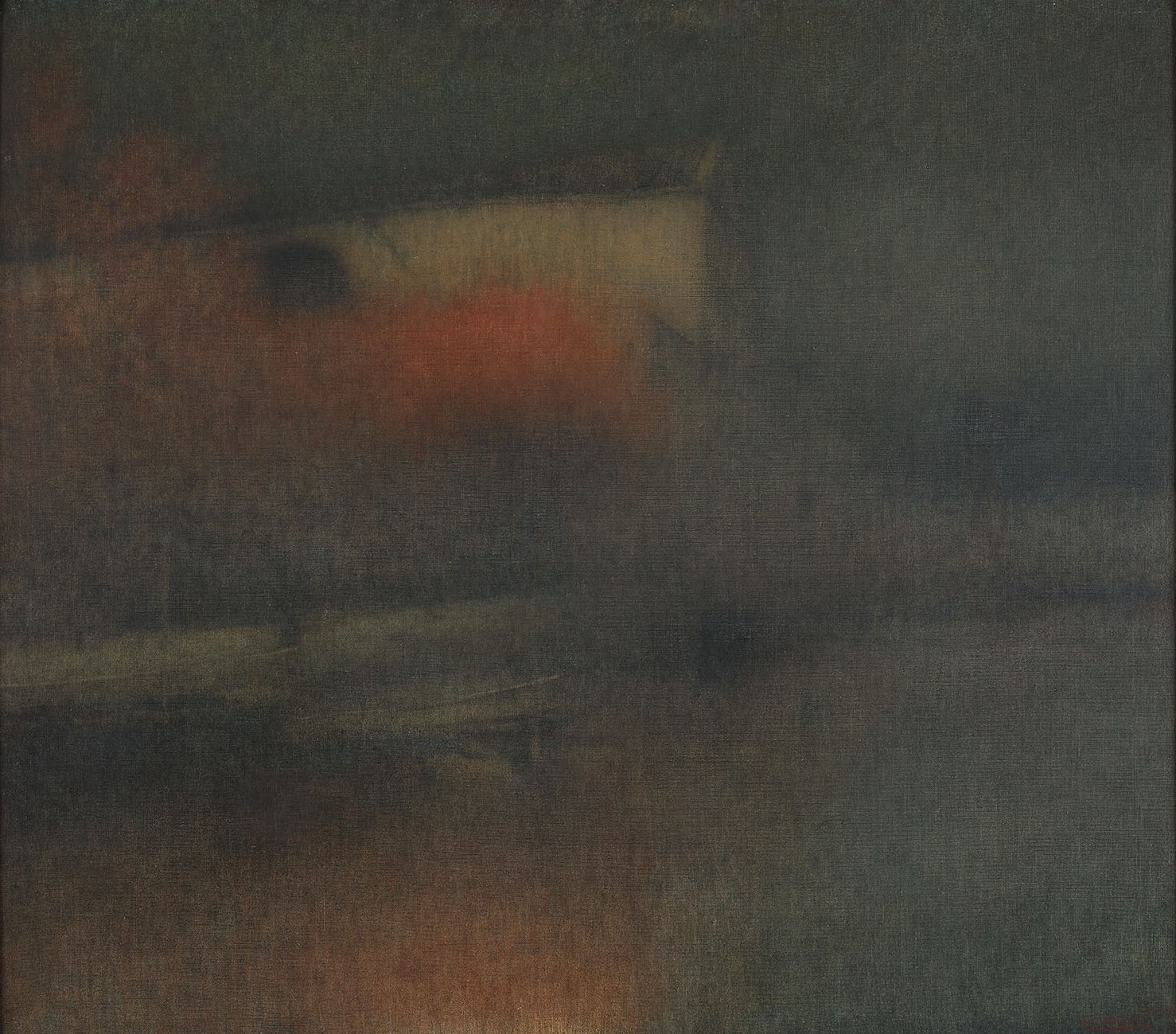
Emanuel Vidović
Old Church in Chioggia, 1907–1908
oil on canvas
86.5 × 97.5 cm
MG-6734
Within the Venice–Milan–Chioggia triangle that marked the formative years of Emanuel Vidović (1870–1953), all scholars emphasize the decisive role of Chioggia. This picturesque fishing town near Venice served as the place where Vidović’s artistic vision matured. It also left a lasting mark on his private life, as it was there that he met his future wife, with whom he would live in Split from the autumn of 1895 onward. Vidović would return to Chioggia and the Venetian Biennales throughout his life.
The abstracted landscape as an image of a “state of mind” can also be recognized in the painting Old Church in Chioggia (1907–1908). In the context of Vidović’s painterly expression, one can readily speak of the influence of Venice and its atmosphere, with its many, often-cited associations with music, literature, and James Abbott McNeill Whistler (1834–1903), within which his metaphorical understanding of landscape is rooted. A general feature of the Venetian painting tradition is a “tendency toward the elegance of the fantastic,” where, as described by Guido Perocco in his 1967 writings on nineteenth-century Venetian painting, already in the late Venetian landscapes of Francesco Guardi (1712–1793) one senses an “immersion in an enchanted atmosphere, enveloped in the emerald greens of water, vast expanses of sky streaked with red and azure tones.” Even its characteristically specific perspective—“in an unreal proportion of human figures to oversized architecture and space”—follows more the course of imagination than reality: everything is fluid and dreamlike in tone […].
Text: Ivana Rončević Elezović, PhD, Museum Advisor at the National Museum of Modern Art © National Museum of Modern Art, Zagreb
Photo: Goran Vranić © National Museum of Modern Art, Zagreb