WHEN POLITICS STRATEGISED AESTHETICS
Artworks from the National Museum of Modern Art Zagreb 1945–1960
Curated by Branko Franceschi & Marta Radman
Kunsthaus Dahlem
Käuzchensteig 12, Berlin
March, 20 – June, 21, 2026
Artists: Antun Augustinčić, Vojin Bakić, Marijan Detoni, Dušan Džamonja, Ivo Gattin, Ivan Jeger, Ksenija Kantoci, Julije Knifer, Slavko Kopač, Vladimir Kristl, Ferdinand Kulmer, Milena Lah, Aurelije Lukežić, Valerije Michieli, Edo Murtić, Ivan Paleka, Šime Perić, Ivan Picelj, Vanja Radauš, Božidar Rašica, Ivan Sabolić, Aleksandar Srnec, Marino Tartaglia, and Josip Vaništa.
With the end of the Third Reich and the division of Germany, first into occupation zones and finally into two separate states, a distinct cultural policy quickly established itself in the eastern part of the country: at the end of the 1940s, a new direction emerged in the visual arts and literature of the GDR, propagated “from above” – from within the party organs: socialist realism. This implementation of an art and cultural policy doctrine was not limited to the GDR. Throughout the Eastern Bloc, socialist realism was imported from the Soviet Union, where it had already been declared the only pictorial model for art and literature in the early 1930s. While it remained the dominant, indeed undisputed model in the GDR for years, Yugoslavia ventured down its own independent path – even though here, too, the implementation of political ideals and ideologies was accompanied by massive repression and political control.
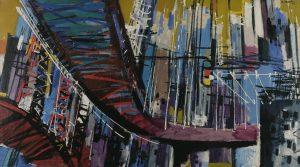
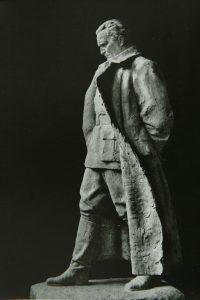
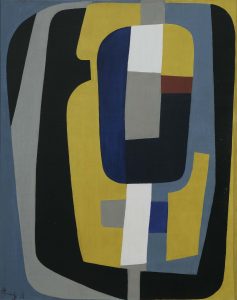
In the aftermath of World War II, the Yugoslav socialist administration and its public cultural institutions promoted forms of art production that emphasised the glorification of partisan resistance and supported public works focused on rebuilding the war-ravaged country. In terms of portraiture, the main focus was on representation of leading communist officials and, above all, the undisputed leader Marshall Tito, whose portraits became obligatory in all public spaces and state institutions. In 1948, the dispute between Tito and Stalin led Yugoslavia to sever its ties with the Communist International and the emerging Eastern bloc; while the Communist Party maintained full control domestically, the state increasingly sought political, military and economic support from Western democracies. For these pragmatic reasons, a distinctive brand of “socialism with a human face” was created and promoted internationally, accompanied by official endorsement of the latest tendencies towards abstraction in international visual art production. The visual arts thus became a valuable instrument of cultural diplomacy, representing both the ambition and creative capacity of local artists to successfully contribute to the development of contemporary visual language, as well as positioning Zagreb as a vibrant international cultural centre in the 1950s – 1970s period. The exhibition presents this shift from socialist realism to abstraction and existentialist figuration through representative artworks commissioned for the collection of the National Museum of Modern Art.
The political background of this aesthetic transformation, however, is rooted in dramatic circumstances. In the immediate aftermath of the WWII in 1945, the Communist Party, leveraging its leadership and the triumph of the anti-fascist resistance, consolidated total political control through the brutal elimination of political opposition, so-called enemies of the state and the people, including defeated collaborators, the bourgeoisie, Volksdeutsche, and politicians with different political agendas or stances. It was a revolution at its cruellest. The exact number of those killed in massacres, death marches, or concentration camps was never established, but it is estimated to be close to 100,000. In 1949, following the break with the USSR and the Cominform Resolution, the Communist Party was “purged” of pro-Soviet supporters through the establishment of re-education camps, among which Goli otok / Bare Island gulag is the most notorious. The number of prisoners on Goli otok alone is estimated at 16,000 – 32,000, with deaths ranging from 400 – 4,000.
This episode in the cultural and political history of Croatian art is just one example of the complex and often tragic collision between political agendas and aesthetic evolution throughout history, which at times produced some of the most remarkable cultural achievements.
Branko Franceschi
Marta Radman
Images:
(1) Edo Murtić, Highway, 1952 / oil on canvas, 82.3 × 145.5 cm, MG-2339 /
(2) Antun Augustinčić, Tito, 1948 / sculpture / cast bronze, 210 × 100 cm, MG-1370 /
(3) Ivan Picelj, Composition “Tyma 3”, 1951 / oil on canvas, 81 × 65 cm, MG-4081 /
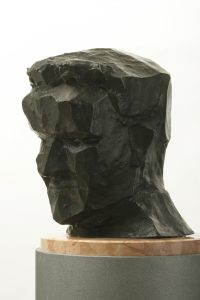
(4) Vojin Bakić, Self-Portrait, 1952 / bronze, 28 × 21 × 22 cm, MG-2596
Photo: Goran Vranić © National Museum of Modern Art, Zagreb