NMMU: At the exhibition in the Josip Račić Gallery, you are showcasing portraits of artists. How many portraits are on display, and who is featured?
Darko Bavoljak: The exhibition comprises 22 photographs portraying 23 artists, with one image featuring the couple Breda Beban and Hrvoje Horvatić, partners in both life and art. The remaining portraits include: Edita Schubert, Duje Jurić, Peruško Bogdanić, Edo Murtić, Goran Fruk, Đuro Seder, Ferdinand Kulmer, Ivan Kožarić, Milena Lah, Šime Perić, Miro Vuco, Željko Kipke, Ivan Lesiak, Zlatan Vrkljan, Slavomir Drinković, Lovro Artuković, Dalibor Martinis, Sanja Iveković, Ksenija Turčić, Tomislav Gotovac, and Slavko Šohaj.
NMMU: In what circumstances were these works created, and do any of them particularly linger in your memory? Perhaps there’s an interesting story behind one of them?
Darko Bavoljak: Some of the photographs on display at the Josip Račić Gallery were originally shown in 1992 at Zdenko Rus’s exhibition “The Eighties in Croatia”, organised by HDLU, though no catalogue was published. The show, held at the Zagreb Fair, was well attended at the time but gradually faded from public memory. Having photographed the works for that exhibition, I was inspired to take portraits of the artists on my own initiative, without any payment. On that occasion, I captured around fifty portraits, and later photographed those who hadn’t been present at the exhibition. Back then, I developed the negatives myself, while analogue photography was still in fashion and widely accessible. Today, the cost of materials has risen sharply, and digital photography has completely replaced analogue due to its technical demands. The negatives have been carefully preserved, so now seemed the perfect moment to share them. Being retired, I finally have the time to devote to my archive.
Two years ago, I showed portraits of Branko Ružić in Slavonski Brod, though those were large-format digital photographs. These, however, are analogue and have been donated to NMMU, intended for use in future exhibitions of the artists depicted.
Over the years, I’ve built a collection of portraits of more than a hundred artists. Back then, we socialised and were quite a close-knit group. The photographs came about quite spontaneously – sometimes I’d call Kožarić and say, “I’ll come and photograph you,” and we’d end up going out for lunch or dinner. For most, I had photographed their work for catalogues and monographs, while some portraits were taken more casually along the way. Photography captures a moment that either happens or doesn’t, and once it’s gone, it cannot be recreated.
I selected these artists with the limitations of the Gallery space in mind, which could not accommodate more photographs. Branko Franceschi, Željko Marciuš, Ivan Posavec, and Žarko Vijatović helped me make the final, careful selection. At times, it was difficult to choose a single portrait from several strong contenders. My goal was to move these artists from a culture of forgetting into one of remembrance. The catalogue was prepared by Ana Zubić and Dragi Savićević.
Today, athletes can choose their own music and performers, yet artists are often overlooked. I believe that those who are central to our culture must be recorded, because artists leave lasting imprints on society’s collective memory.
My relationship with Tom Gotovac was like Dr Jekyll and Mr Hyde. We loved each other, but we argued as well. I stayed by his side until the very end and made two films about him, one of my favourites being Stupid Antonio Presents. We had been preparing it for three or four years, and then he came to my studio, and we shot everything in just three hours. He was fully prepared and focused, and the footage practically edited itself. I used an inventive technique, filming him against a Chroma Key background and then cutting him out, while behind him ran three of his own films, Don’t Ask Where We’re Going (1966), T (1969), and Glenn Miller I (1977), forming a trilogy that explores nudity, the mother, and art. He talks about why he undresses, his relationship with his mother, and his art, and how he came to form his identity as an artist. All of which is key to understanding his perspective on the world and his work. As a child, he admired Meštrović and was fascinated by The Fountain of Life, observing nude figures and developing an understanding of the body that he later carried into his own practice. I photographed Gotovac for the exhibition in 1993 as part of a series commissioned by Dario Marković, editor of Kinoteka, who wanted a nude portrait of Tom for the cover. When Tom came to my studio, I stepped away to prepare some things, and in that brief time he undressed, explaining, “Listen, pal, I feel very awkward undressing in front of you, so I took the opportunity while you were gone.” That’s how the photographs came about. This is one of the portraits from that series, previously unpublished.
Ksenija Turčić and I belong to the same generation; we met in the late 1980s while she was at the Academy, and our friendship has lasted ever since. I photographed extensively for her exhibitions, and this portrait dates from 1992.
I shared a particularly close bond with Miro Vuco. We met in the 1990s when Ante Rašić asked me to photograph the catalogue for Vuco’s monument to Tin Ujević, then installed in Varšavska Street, and we immediately clicked.
I regret that there is no portrait of Branko Ružić here, with whom I was also very close. Since I had already exhibited his portraits in Slavonski Brod, I did not want to repeat myself. Ružić, Vuco, and Kožarić were the ones I had the closest relationship with. I even travelled to India with Kožarić for two weeks, simply for pleasure. I vividly remember a conversation he had with an Indian man: Kožarić spoke in his idiosyncratic French, probably incomprehensible even to the French, while the Indian spoke in his own language, and they conversed like that for half an hour. I will never forget that scene. Following that trip, we held a joint exhibition at Marina Viculin’s gallery in Lotrščak Tower.
I served alongside Vrkljan and Bogdanić during the war in the Art Battalion, where our relationships ranged from close and friendly to tense and complicated.
There are also people I only ever encountered while photographing them and never saw again.
I didn’t have a personal connection with Šime Perić, but photographing him revealed a remarkable sense of artistry. This was for the exhibition “The Eighties in Croatia”, for which I also photographed Count Kulmer. I took his photo at the Academy. He was engaging, charming, and cultured.
Photographing Edo Murtić, however, was something else entirely. I arrived at his studio on Zrinjevac, the former Bukovac studio, around 10 am and stayed until 1 pm. In those four hours, he completed a two-metre painting from halfway to the end, painted another of the same size from scratch to halfway, produced around ten sketches, handled twenty phone calls, and saw five visitors. All while I photographed him. Whiskey sat on the table, conversations and interviews took place, yet he still found time to paint. In 1990, he was at the height of his powers. A force of energy and creativity that simply radiated.
The first portrait in this exhibition that I photographed was of Edita Schubert for her show at Beck in the early 1990s. I later collaborated with her more extensively, often visiting her at work at the Institute of Anatomy, where she also worked as a draughtswoman in the mortuary section of pathology.
Dalibor Martinis, my professor at the Academy, was another artist I photographed. After graduating in 1991, I arranged to visit him at his home on Savska Street; at the time, he was still married to Sanja Iveković, whom I met during the shoot for the exhibition The Eighties.
I photographed Peruško Bogdanić at his exhibition in the Forum Gallery in 1990.
Among the works on display, Slavko Šohaj was the last artist I photographed, in 1995, at his studio on Križanićeva Street. I remember photographing his works and having one final shot left, so I asked if I could take his portrait. I took the photograph and, having no more film, left. I hadn’t opened that file until recently, and I was surprised at how striking the portrait was.
For a time, I had a close professional and personal relationship with Željko Kipke, though we later went our separate ways.
I photographed Artuković while he was still living in Zagreb…
Milena Lah was a remarkable and distinctive presence, always different, and I’m glad I was able to capture a few of her portraits.
I remain friends with Duje Jurić and continue to photograph him for exhibitions.
Goran Fruk, now largely forgotten, tragically died in 1993 while hiking on Sljeme, shortly after I had photographed him for an exhibition at the Extended Media Gallery on Starčević Square. I’m pleased that his portrait is shown here alongside Seder, as Fruk had been his student at the Academy. He was highly avant-garde and could not accept the Academy’s rules, often clashing with everyone there, yet Seder cared for him deeply. Fruk is also known for his defenestrations and other artistic actions in the 1980s, particularly on Flower Square.
I also had a close and intense relationship with Seder, which began when I was photographing his monograph, written by Vlastimir Kusik and Zdenko Rus. I spent every day in his studio, carrying lights up to his fourth-floor studio at the Academy and photographing all his works from that period. We even planned a trip to Nova Bila, where he was creating paintings for the Franciscan monastery at Plehan, but he cancelled at the last minute, and after the war broke out, it was no longer possible. Those works were never documented, as everything was destroyed.
I had a wonderful relationship with Lesiak as well. He was very particular about his appearance and would ask me to bring him the negatives after a shoot. If he didn’t like how he looked in a photo, he would cut it up and discard it, leaving me only the images in which he thought he looked good.
And then there was Drinković, imposing and strong, yet gentle in spirit. He even designed the stairs for my house; he was fascinated by building. I paved the courtyard with leftover stone from his monuments. He was always eager to help.
NMMU: None of your colleagues, including other photographers and some of your closest friends, appear in the portraits you’re showing?
Darko Bavoljak: After the Račić exhibition, I plan to publish a book of artist portraits featuring over a hundred artists, including fellow photographers. I want to cover a wider period and include everyone who deserves to be remembered and who has made a mark on our culture.
NMMU: Your wife is a curator. In what ways do your careers overlap, and where do they differ?
Darko Bavoljak: We’ve collaborated on several projects and even co-authored a few texts for publications. She has always been a constant source of support in my life, and that support continues with this exhibition.
NMMU: At one stage, you documented the closure of shops and shop windows where life once thrived, and their transformation into emptiness… Why did these empty displays leave such an impression on you?
Darko Bavoljak: In the Empty Windows series, I saw the life that had once existed there and sensed a visual quality that symbolises the history of these spaces, both when they were active and now, once they had closed. All the windows were photographed in Zagreb, and the exhibition, curated by Iva Prosoli, travelled to several cities.
NMMU: How do you remember your time at Polet, Studentski list, Svijet, and Start?
Darko Bavoljak: It shaped the way I view the world and clarified my vision of what I want to show. I was particularly influenced by Ivan Posavec and Mio Vesović. My studies at the Academy of Dramatic Art were equally important, where I learned from Goran Trbuljak, Tonko Maroević, Radovan Ivančević, Ante Peterlić, and Hrvoje Turković. It was there that I mastered the techniques of photography, deepened my understanding of art history, and learned the theoretical principles of composition and framing.
NMMU: At the end of 2025, you presented the series Return at Lamparna Gallery in Labin, which reflects on the pandemic. How did it affect you?
Darko Bavoljak: Curated by Iva Prosoli, the series was first shown in Koprivnica, then in Zagreb at the Gallery on the KIC upper floor, and finally in Labin. I experienced the pandemic without any health problems and saw it as a pause from everyday life, a chance to work on projects I wouldn’t normally have been able to pursue. I took a large-format camera to Medvednica to capture the natural decay of trees felled by storms, searching for scenes of natural disaster untouched by human hands.
NMMU: One of your series focuses on travel. How would you describe travelling through your own life?
Darko Bavoljak: The photographic series Travelling (curated by Marina Viculin) explores the aesthetics of the moment and the perception of space and time. I see the meaning of life in leaving a trace of one’s existence and in making the environment in which I live a little better.
NMMU: Do you sometimes feel like a stranger in your own time?
Darko Bavoljak: I try to be adaptable, keeping up with technology while holding on to aesthetic and ethical standards. I’m also actively involved in public life through the Goli Otok Association, working on confronting the past and defending human rights.
NMMU: Despite overpopulation, do you think we live in De Chirico’s “empty cities”?
Darko Bavoljak: The world today is full of extremes and self-satisfied politicians whose only concern is power. Decisions about culture are often driven by bureaucratic and statistical mindsets, treating it as a cost rather than a source of value. In such a climate, engaging with the past and fostering a culture of memory carries no political advantage. Historical revisionism and a culture of forgetting currently dominate, and the future under these conditions promises little that is positive – something I already explored in my 1992 photographic series Future.
Interviewed by: Lana Šetka, National Museum of Modern Art, Zagreb
Translated by: Robertina Tomić
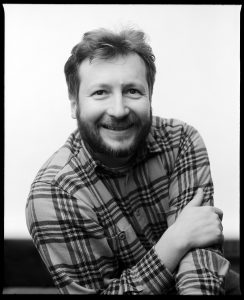
Photo by: The portrait of Darko Bavoljak was taken by Mio Vesović in 1994, when they photographed each other. / Courtesy of Darko Bavoljak