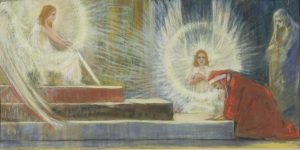
Bela Čikoš Sesija
From Dante’s Inferno, 1904
Pastel on paper
24.7 × 49.2 cm
MG-523
Bela Čikoš Sesija (1864–1931) is regarded as one of the most important representatives of Symbolism in Croatia. He studied painting at the Academy in Vienna under Julius Berger and Leopold Karl Müller, and later specialized in Munich under Wilhelm von Lindenschmit. He undertook two study trips to Italy, primarily to study classical heritage in order to realize Izidor Kršnjavi’s programme for the artistic decoration of the building of the Department of Worship and Education. In April 1892 he travelled to Venice, Padua, and Florence, while his second journey was connected with a stay in the vicinity of Naples during 1893–1894, when, following the tradition of European Grand Tour artists, he painted plein-air landscape studies.
Upon returning to Zagreb, he collaborated with Vlaho Bukovac, as evidenced by his painting Bukovac While Painting How Gundulić Imagines Osman (1894). He subsequently attended the school of Carl von Marr in Munich. In 1895, Čikoš returned to Zagreb, where he remained artistically active until the end of his life. His pedagogical role in Croatian art was of great significance: from 1907 he worked as a professor at the Higher School of Arts and Crafts in Zagreb, which in 1921 developed into the Academy of Fine Arts.
Rendered in indistinct pastel tones, Dante is depicted kneeling at the foot of stone steps, dressed in red and white garments. At the top of the steps, shown in profile, sits a winged angel holding a sword, surrounded by a luminous halo. To the side of Dante, in the right half of the composition, another angel is shown frontally, also encircled by a halo of light. Along the right edge of the image, against a bluish background, stands a pale figure wrapped in a long hooded cloak.
Čikoš’s pastel From Dante’s Inferno, created in 1904, continues the tradition of his painting from the 1890s. In selected works from this period, we observe the characteristic application of a variant of the Divisionist technique, marked by linear, stroke-like brushwork, subdued chromatic range, and mixed tones serving a Symbolist mode of expression. This approach was popularized and modified within the Central European context, particularly in Vienna. Compared to Bukovac—who was among Croatian painters, and later at the Academy in Prague, the principal disseminator of this painting technique—Čikoš demonstrates a more pronounced inclination toward literary themes, characteristic of Symbolism. This is evident in works employing the described Divisionist variant, such as Walpurgis Night (1896), Dante Before the Gates of Purgatory (1898), and Athena Kissing Psyche (Inspiration) (1898).
Text: Ivana Rončević Elezović, Phd, museum advisor at the National Museum of Modern Art © National Museum of Modern Art, Zagreb
Photo: Goran Vranić © National Museum of Modern Art, Zagreb