Ivo Režek
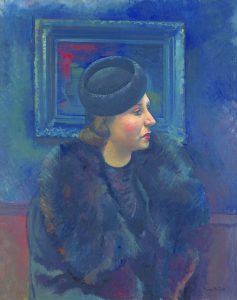
Portrait of My Wife Marija, 1939
oil on canvas
79 × 62.8 cm
MG-1143
In Portrait of My Wife Marija, Ivo Režek depicts a female figure shown in profile, set within an interior rendered in almost monochromatic blue tones. This restrained palette creates a calm, intimate atmosphere characteristic of his Magical Realist approach of the 1930s. The figure is monumentalized through clear contours and firmly modeled volumes, while softly graduated transitions of light and shadow emphasize the refinement of facial features and the elegance of the attire.
The fur collar, dark hat, and subtly pink complexion form a strong chromatic contrast with the cool background, intensifying the psychological isolation of the portrayed woman. In the background, a framed painting appears—a motif that introduces an additional spatial and symbolic layer, contributing to the magical-realist suggestiveness of the scene not only through description but also through a quiet narrative charge.
Here, Režek combines Cézannian discipline in the construction of volume with a later inclination toward clarity of form and poetic distance, creating a portrait in which refined psychological insight, subtle chromatic harmony, and structural stability function as a unified whole. The work demonstrates the artist’s interest in elegance and introspective atmosphere, while the profile view, discreetly dramatized by side lighting, accentuates the dignity and mystery of the female figure.
Ivo Režek (1898–1979) was a Croatian painter, graphic artist, and caricaturist. He was educated in Prague, where he graduated from the Academy of Fine Arts in 1924, and later specialized in fresco painting in Paris in 1928 under Marcel Lenoir. In his early works, he drew on Cézanne’s approach to modeling volume and the tradition of the Munich School. By the mid-1920s, he worked in the spirit of the Neoplastic tendencies of André Derain and Pablo Picasso, developing Magical Realist compositions of female nudes, bathers, and monumentalized portraits. During the 1930s, he focused on psychological portraits, still lifes, and motifs from his native Zagorje region. After the Second World War, he continued to pursue a realist treatment of landscapes and coastal scenes. Režek also illustrated books (A. Kovačić, U registraturi, 1944; M. Krleža, The Battle of Bistrica Lesna, 1958) and worked as a caricaturist under the pseudonym Ives, collaborating with the magazines Kopriva and Kerempuh.
Text: Lorena Šimić Majić, Curator / Museum Educatorat the National Museum of Modern Art © National Museum of Modern Art, Zagreb
Photo: Goran Vranić © National Museum of Modern Art, Zagreb