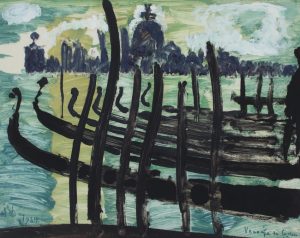
Slavko Šohaj
Venice, 1984
tempera on paper
48.5 × 60.5 cm
MG-7506
Slavko Šohaj (1908–2003) graduated from the Academy of Fine Arts in Zagreb in 1931, where he studied under Ljubo Babić (1890–1974) and Vladimir Becić (1886–1954). He continued his artistic training in Paris from 1931 to 1932 and returned there again in 1939. In 1934, he participated as a guest exhibitor with the Group of Three. From 1935 to 1965, Šohaj worked as an art associate of the Archaeological Museum in Zagreb, and in 1977 he became a member of JAZU (today the Croatian Academy of Sciences and Arts – HAZU).
His painting is distinguished by a coloristic virtuosity within a realist idiom characteristic of the mid-20th century, with a clear homage to the legacy of Paul Cézanne (1839–1906) and Henri Matisse (1869–1954). Šohaj’s inclination toward improvisation is particularly evident in his works in colored drawing, watercolor, and gouache.
This group of works includes Venice by Slavko Šohaj from 1984, which follows the grammar of coloristic and formal minimalism. The composition is marked by a finely rhythmic, geometrized, and abstracted syntax of parallel gondola curves, intersected at right angles by the characteristic vertical wooden posts marking navigation routes. This structure frames the well-known silhouette of the city, dominated by the dome of the church of Santa Maria della Salute, rendered in dark tones.
Text: Ivana Rončević Elezović, PhD, Museum advisor at the National Museum of Modern Art © National Museum of Modern Art, Zagreb
Photo: Goran Vranić / National Museum of Modern Art, Zagreb