NMMU: Can you share some insights into the recent works you’ll be presenting in the Stories Backwards exhibition at the Josip Račić Gallery?
Ivona Šimunović: Reflecting on my new series and the process of creating the pieces for the Josip Račić Gallery, I became aware of the central role that the temporality of memory plays in my painting. It continually raises the question of how time leaves its mark on an image, and how a painting can hold on to what is slipping away. Memory, after all, is never fixed; it is changeable, shaped by both the passage of time and the act of perception. A painting becomes a space where past and present intersect, where experiences and emotions are not reconstructed but reformed through colour and form. In my work, I consider how mutable our memories are, and how visual representation can transform them into something that transcends the personal and becomes something universal, which in the end is what allows a work to endure and sustain itself.
In this exhibition, I am presenting two series, comprising around ten oil-on-canvas works in various formats. Each series I have created builds on the one before it, tracing backward from my most recent works, which engage with certain dedications, legacies, losses, and the time that followed. There is a thread that runs through them, something like an alternate reality, that emerges spontaneously. These series are a direct response to particular moments in my life; they are deeply personal and reflect my lived reality. I believe that such realities resemble one another in all of us, to the point that we could even exchange them without necessarily noticing.
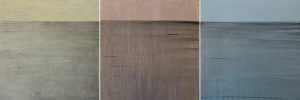
The exhibition brings together a series of recent works in which I explore the memory of a life story, events partly lost, then recovered, as layered traces of experience that are not a simple chronological record, but a field of memory, fragmented, constantly shifting, and open to reinterpretation, forming an archive of inner emotional states. The second series, subtly connected to the first, depicts a constant presence of both psychological and tangible landscapes, where the horizon defines the space I inhabit, as a persistent sign of what is yet to come, though never fully realised.
NMMU: How do you understand time and its passing? Which moments or events do you “return” to in these works?
Ivona Šimunović: I’ve realised that what I do is often situated between abstraction and figuration, and is essentially a biography of my memories. My painting process is always grounded in memory, which is fluid and fleeting, like time itself. These memories take shape as a map of intimate states that extend beyond personal experience, opening up spaces for universal recognition and allowing observers to project their own experiences onto the work. Painting is always a dialogue between the inner and outer worlds. My works, as acts of reminiscence, select striking life events, each unique, and as such they appear dispersed within a series. It is precisely this sense of dispersion that reflects my exploration of the boundaries of focus. In this new series, I present fragments that together trace a personal history, recording, almost like a visual diary, thoughts, experiences, emotions, and events from an extended period, not necessarily simultaneous. I do not revisit specific events; what interests me is how they fade, while some become more vivid. They do not follow a chronological order, but emerge in fragments. I believe that every act of remembering transforms what is remembered, so the paintings convey not events themselves, but the experience of their passage.
NMMU: If you could turn back time, at which moment would you choose to “pause” it?
Ivona Šimunović: If I could return to any period of my life, it would unquestionably be the years when my children were small. It’s not about a specific date, but a particular quality of time. I would return for the sheer intensity of those moments. The days felt long, yet the years passed quickly. I remember that time as a series of beautiful experiences, marked as much by the richness of presence as by the events themselves.
NMMU: Apart from being a source of spiritual richness and joy, do you think memories can also be an emotional burden?
Ivona Šimunović: It depends. Some bring joy, others a certain weight, and some carry quiet stillness. I use them in my work as a space where past and present meet.
NMMU: What are your memories of Dubrovnik from your childhood? How much has it changed, and what do you miss most about it today? And what has always inspired you there?
Ivona Šimunović: In my memory, Dubrovnik of my childhood moved at a slower, yet more intimate pace, with a rhythm all its own. It still bore the marks of war, fragility and vulnerability, but in a quietly dignified way. The city had its own empty spaces, which made it a wonderful place to grow up. It somehow felt entirely ours. Yet every period inevitably carries its own character and echoes, so no moment can be idealised. What has always inspired me about Dubrovnik is its enduring and timeless beauty.
NMMU: You work as an educator at the Museum of Modern Art Dubrovnik. What do you find most rewarding about this role, and what do you see as its greatest responsibility?
Ivona Šimunović: Without a doubt, the greatest reward is working with children and young people. Pure creativity! Museum educators aim to nurture an audience for whom art does not feel unfamiliar, helping them discover how it can enrich their lives in many ways. Through various approaches, whether guided tours or creative workshops, our main goal is to create new experiences through engagement and emotion, to foster creativity and critical thinking, and to build a bridge between everyday life and art.
NMMU: When do your best ideas tend to emerge?
Ivona Šimunović: I think the process is far more important than the idea itself. The idea serves only as a guide, while the real value lies in discovery and interpretation. In painting, I don’t rely much on ideas; what interests me most is the act of creation. I tend to think of an idea as a concept, a reflection of experience and a framework for interpretation.
NMMU: Who would you like to see at the opening of your exhibition in Zagreb?
Ivona Šimunović: I like to think of Zagreb as my third home, after Dubrovnik and Lopud. It’s where I spent my student years, and I would love to welcome dear friends, fellow artists, and anyone who shares a love of art at the exhibition.
Interviewed by: Lana Šetka, Nacionalni muzej moderne umjetnosti, Zagreb
Translated by: Robertina Tomić
Reproductions:
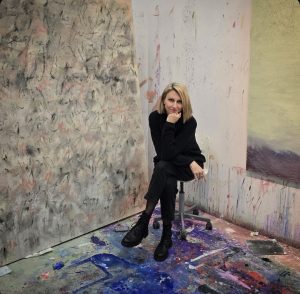
(1) Painter Ivona Šimunović in her studio in Dubrovnik / Photo from the artist’s private archive / Courtesy of the artist
(2) Ivona Šimunović, Different Horizons / triptych, 2025, oil on canvas, 150 × 450 cm / Photo: Miho Skvrce,