The exhibition Latica Ivanišević – A Token of Beauty, opening on Wednesday, 12 November 2025 at 7 p.m. in the exhibition space of the National Museum of Modern Art in the Oktogon (in the former First Croatian Savings Bank building), contextualises the artistic work of Latica Ivanišević within the fascinating story of her family. The Ivanišević, Šilović and Gavella families were for generations a gathering place for some of the most prominent figures in Croatian culture and art. This is vividly illustrated by a series of exhibited portraits by great masters such as Jerolim Miše, Vanja Radauš, Zlatko Prica, Marta Ehrlich, Fedor Vaić and Edo Murtić, as well as by numerous photographs, documents and mementos from the family archive. While her father, Drago Ivanišević, poet and erudite, appears as a painter through a selection of his surrealist drawings, the artistic output of Latica Ivanišević is presented through a series of vividly coloured and large-scale tapestries, textile collages, theatrical costumes, and works in enamel, ceramics and clay.
The exhibition A Token of Beauty, curated by Lada Bošnjak Velagić, announces the donation of Latica Ivanišević’s works to the National Museum of Modern Art and the Museum of Arts and Crafts. Conceived as an exhibition about beauty as a gift and source of inspiration, it features fifteen artists and fifty exhibits, and will remain open until december 7 2025.
The exhibition is realised with the support of the Ministry of Culture and Media of the Republic of Croatia.
Artists featured
Latica Ivanišević, Grga Antunac, Kruno Bošnjak, Marija Braut, Milan Butozan, Marta Ehrlich, Drago Ivanišević, Jerolim Miše, Edo Murtić, Miranda Morić, Ratko Petrić, Zlatko Prica, Vanja Radauš, Stipe Sikirica, Fedor Vaić
Artist Biography
Latica Ivanišević (Zagreb, 1942) graduated from the Faculty of Law in 1965 and held her first solo exhibition in 1970 at the Museum of Arts and Crafts, where she also presented notable costume designs for a dance ensemble performing at the opening of the Théâtre Espace Cardin in Paris. Although initially recognised as a master of enamel, she later began incorporating everyday, non-artistic materials such as plastic, wire, and recycled fabrics into her stage and costume designs, creating scenographic compositions from textiles, tapestries and textile collages.
In addition to numerous theatre collaborations (Croatian National Theatre in Zagreb, Split and Osijek, Zagreb Youth Theatre, Gavella, Teatar u gostima, Dubrovnik Summer Festival, Slovenian National Theatre in Ljubljana and Maribor, among others), since 1975 she has worked continuously with Television Zagreb (now HRT) on entertainment, documentary, dramatic and film projects. From her scenography for Macbeth directed by Vjekoslav Habunek (Dubrovnik Summer Festival, 1970), featuring innovative enamel elements, to later works such as Three Cavaliers of Miss Melania (HNK Zagreb, 1974), Chinese Vases (RTZ, 1978), Romeo and Juliet (SNG Maribor, 1981), Love at First Sight (Teatar u gostima, 1982), Without a Third (RTZ, 1989) and Transfiguration (HRV, 1999), her work is distinguished by imagination, visual refinement, and a keen sense of stage composition.
Beyond scenography and costume design, she also creates enamel jewellery, tapestries and ceramic sculptures. She has held solo exhibitions in Zagreb, Dubrovnik and Karlovac, and participated in numerous group exhibitions. She is the author of two books, Listen and Look, Latica (Naklada Ljevak, 2010) and The Woman with Sad Eyes (Naklada Ljevak, 2012), as well as numerous articles published in periodicals.
Reproductions:
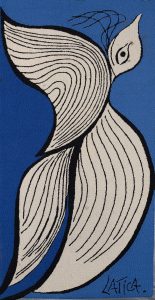
(1) LATICA IVANIŠEVIĆ, Bird I, 1999., lining: cotton; pile: wool; manual tufting technique (made by SagaSaga), 195 x 100 cm
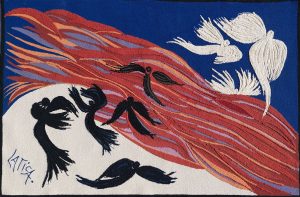
(2) LATICA IVANIŠEVIĆ, Birds, 1999., lining: cotton; pile: wool; manual tufting technique (made by Zdenko Jerneić Studio), 200 x 300 cm
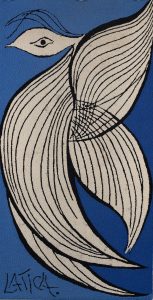
(3) LATICA IVANIŠEVIĆ, Bird II, 1999., lining: cotton; pile: wool; manual tufting technique (made by SagaSaga), 195 x 100 cm
Photos: Goran Vranić © National Museum of Modern Art, Zagreb