Josip Račić
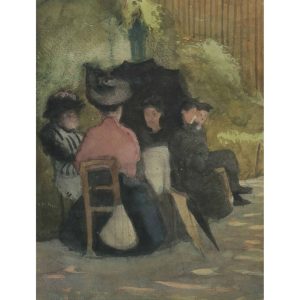
In the Park (In Conversation II), 1908
Watercolour on paper
28 × 22 cm
MG-764
In a letter to his father dated February 1, 1908, Račić expressed his decision to travel to Paris in order to further develop and advance as a painter. He arrived in Paris on February 10, 1908, where, within just four months, he created some of his most important works.
During his first weeks in Paris, the winter led him to spend much of his time in museums and galleries, studying the works of the great masters. With the arrival of spring, however, the mild climate and the vibrant atmosphere of the city drew him outdoors. Račić increasingly frequented the parks, observing everyday life that became the source of many of his motifs.
It was in the Parisian parks that Račić produced a series of watercolours depicting social scenes, rendered through his distinct artistic lens, such as In the Park (In Conversation II), painted in 1908.
These leisurely urban scenes identify Račić as a Baudelairean “painter of modern life,” a flâneur – a stroller through the streets of the modern metropolis. He bore witness to its dynamism, constant change, and the multitude of sensations offered by modern society, interwoven with diverse social relations and conventions shaped by modernity. The backdrops of this life were cafés, theatres, parks, and streets. Račić captured them all in watercolour, with swift and assured brushstrokes that echoed the excitement of urban flux itself.
Paris appears here as a living mega-organism, and Račić’s watercolours – including his Pont des Arts – are not contemplative city views but vivid testaments of enthusiasm: for movement, light, monumental architecture, and the very moment of creation.
Text: Tihana Galić, Curator at the National Museum of Modern Art © National Museum of Modern Art, Zagreb
Photo: Goran Vranić © National Museum of Modern Art, Zagreb