Mirko Rački
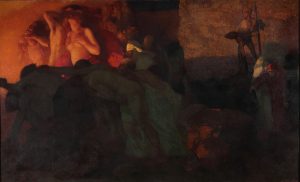
Crossing of the Acheron, 1907
oil on canvas
141 × 230 cm
MG-843
A favourite theme of Symbolist painting was literature, particularly Dante. Alongside Vlaho Bukovac, who painted scenes from Dante’s cycle, Mirko Rački (1879–1982) stands out as the artist whose oeuvre was most profoundly marked by this subject. He first turned to Dante at the suggestion of Izidor Kršnjavi, who at that time had translated the Divine Comedy into Croatian. Rački produced a series of illustrations for Dante’s work, later published in the Croatian edition, as well as several large-scale painterly adaptations. We know that the sketch for The City of Dis (1906) was created during his stay in Venice. Rački devoted almost his entire career to this Dantean cycle. His drawings, gouaches, and watercolours for Kršnjavi’s translation, produced between 1904 and 1907, were purchased at an exhibition in Italy in 1911 and are today preserved in the Print Room in Florence.
In this large, horizontally oriented composition, rendered in a crepuscular manner with a dark palette heightened by accents of orange-red, Rački depicts a scene from Dante’s Inferno. The lower two-thirds of the canvas are enveloped in a nearly black shadow through which bent and suffering figures can be discerned. In the upper left corner, a group of nude figures, lit with orange-red highlights, are shown from the waist up in contorted poses of agony. At the far right edge stand Dante, dressed in red, and Virgil, in white. In the upper right corner looms a demonic guardian with a sword.
The River Acheron—one of the five rivers of the Underworld in Greek mythology, described as the river “of sorrow and distress” across which the ferryman Charon transports the souls of the dead—is reimagined in Dante’s Inferno as the boundary of Hell, situated in the so-called Ante-Hell. By transposing Dantean motifs into oil painting, as exemplified in Crossing of the Acheron (1907), Rački employed a mediated and modified version of Piedmontese-Lombard Divisionism. Stripped of pronounced chromatic intensity, with blurred transitions of blended tones and linear pennellata, this approach generated the tense, vibrating surfaces characteristic of Symbolist canvases. The European popularisation of this painterly technique owed much to Giovanni Segantini, whose influence was strongly felt in the artistic milieus of Vienna and Munich. Moreover, as with Čikoš, Rački’s engagement with Divisionist methods can also be partly attributed to his contact with Bukovac. Thus, the painting reflects a typical Central European adaptation of mediated Divisionism in the service of Symbolist expression—an approach characteristic of the late 19th and early 20th centuries, and one that particularly shaped the artistic production of the Zagreb circle.
Text: Ivana Rončević Elezović PhD, Senior Curator at the National Museum of Modern Art © National Museum of Modern Art, Zagreb
Photo: Goran Vranić © National Museum of Modern Art, Zagreb