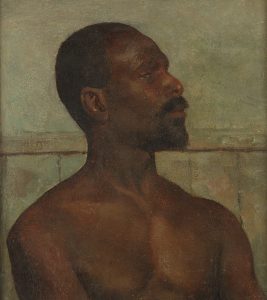
Vlaho Bukovac
Head of a Black Man
1877–1878
oil on canvas
36.5 × 29.5 cm
MG-3886
Vlaho Bukovac (1855–1922), the initiator of Croatian modern art, was a curious and adventurous spirit who had already travelled to America as a child. Thanks to the Pan-Slavic-oriented writer Medo Pucić and Bishop Josip Juraj Strossmayer, Bukovac enrolled at the Parisian École des Beaux-Arts, where he studied under Alexandre Cabanel. Over the years, he became familiar with Impressionist painting and developed his own artistic style, drawing on Realism, Impressionism, and occasionally Symbolism. He was one of the initiators behind the construction of the Art Pavilion in Zagreb, and in 1897 he founded the Society of Croatian Artists, which opposed Izidor Kršnjavi’s Croatian Society of Art by advocating for plein-air painting—thus giving momentum to Croatian modernism. Under his influence, painters began working with a lighter palette and developed a variant of Croatian realist painting with bright coloration known as the Zagreb Colourful School. Due to disagreements with Kršnjavi, Bukovac left for Cavtat in 1898, and in 1903 moved to Prague, where he became a professor at the Academy of Fine Arts.
The painting Head of a Black Man depicts a profile portrait of a young African American man with regular facial features and a bare, muscular torso, set against a neutral background. His short black hair sharply defines the contour of the skull, as do the precisely rendered moustache and short beard. It is known that Bukovac painted portraits quickly, in just a few sittings, and always strove to establish communication with the sitter. Fascinated by the Oriental and the exotic, Bukovac explores the facial characteristics of the young man, imbuing the image with depth and dignity. Although the portrait is rendered with an individualistic approach, the historical context of its creation carries latent currents of objectification and colonial bias. Exoticism, as a defining ethos of the European imagination in the 18th and 19th centuries, is reflected in the depiction of Black figures, which became lasting and influential symbols of the period’s fascination with the exotic.
Text: Marta Radman, curator of the National Museum of Modern Art © National Museum of Modern Art, Zagreb
Translated by: Marta Radman / Photo: Goran Vranić © National Museum of Modern Art, Zagreb