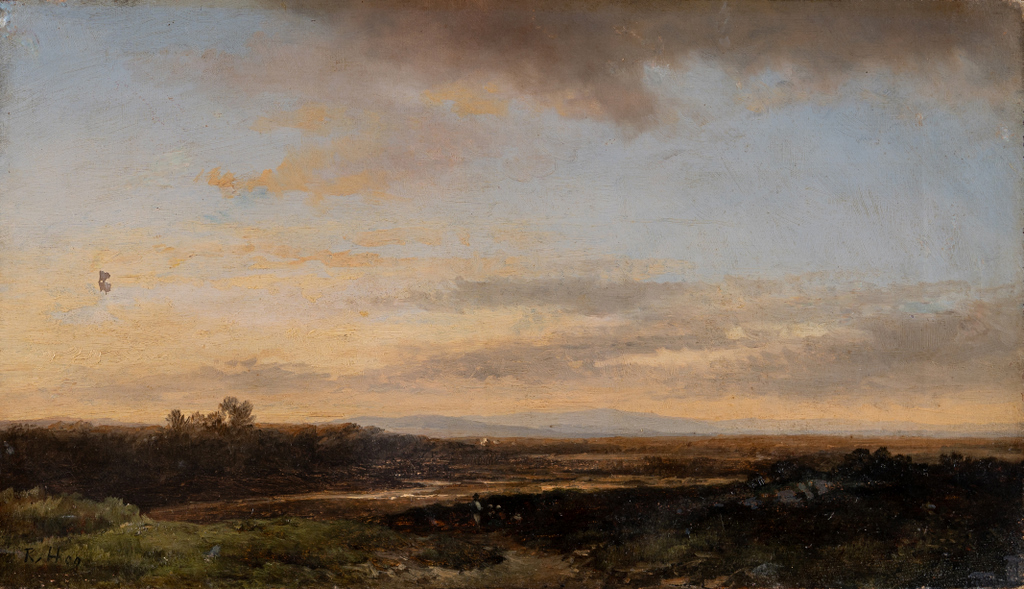
R. HOG ili R. H (?), Landscape, 19th Century, oil/canvas, 31 x 54 cm, MG-52
Foto: Jovan Kliska
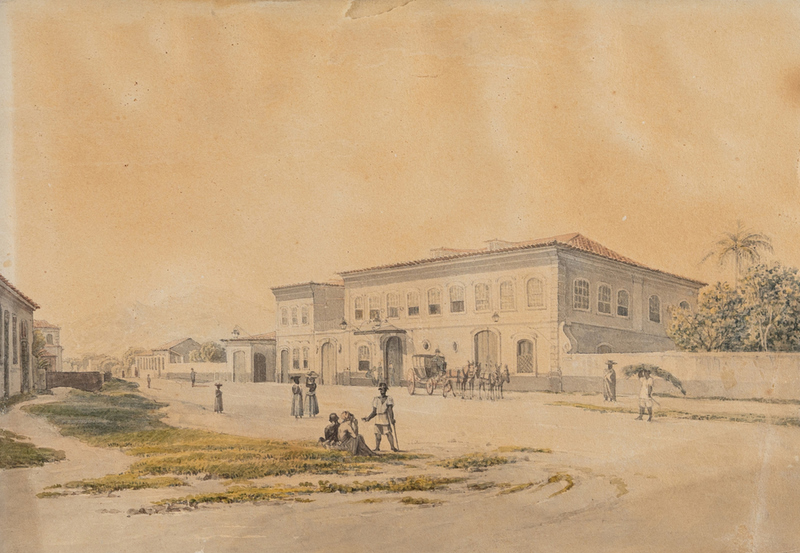
Thomas Ender (?), Street View with Figures, 1817–1820., paper/watercolours, 19,5 x 28,5 cm, MG-1851
Foto: Jovan Kliska
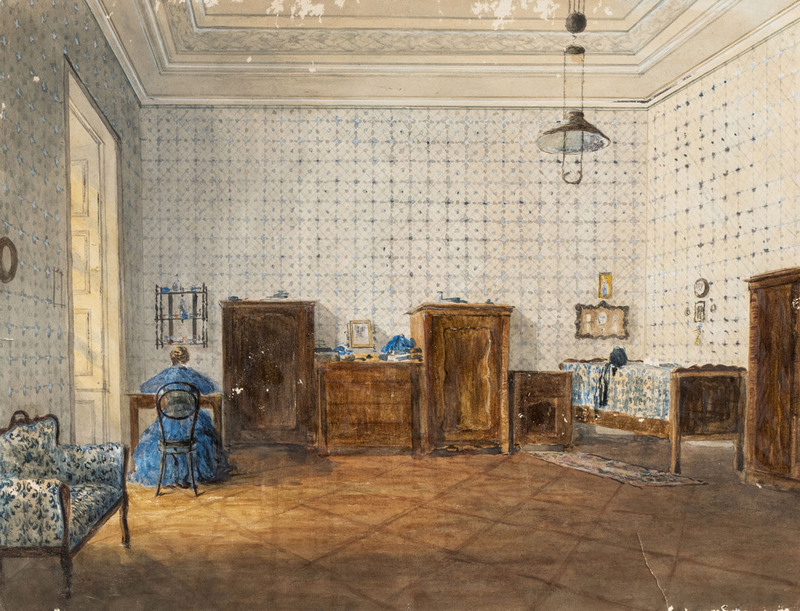
Anon.,Interior of a Biedermeier Room, 19th Century, paper/watercolours, 30,5 x 40,5 cm, MG-1854
Foto: Jovan Kliska
Landscape, Veduta and the Interior
Ivana Rončević Elezović, Ph.D
Back to Unattributed and Undated works
Landscape, Veduta and the Interior
The history of landscape painting traces the genre’s gradual emancipation: from serving as a mere backdrop for historical or religious scenes, or as a setting for portraits, to becoming an independent form in its own right. At times, small, barely perceptible staffage figures were still included as a ‘pretext’ for the scene (as often seen in Renaissance painting), or to convey subtle shifts in meaning, as in Symbolist works at the turn of the 19th to 20th century. In the latter case, tiny human figures (often archetypal shepherds with their flocks) appear within vast natural expanses, symbolising both the interconnectedness of human beings and the overpowering force of nature.[36]
Often considered within the landscape genre is the urban variant, or veduta, with topographical vedute representing a distinct subcategory. Topographical vedute were particularly common in the first half of the 19th century, and are characterised by precise representation, strong linearity, and frequent use of watercolour. Their primary purpose was historical and documentary, with artistic value considered secondary. The NMMU Collection includes several such unattributed topographical vedute, comparable, for instance, to the similar collection of watercolours by the Austrian painter Franz Jaschke (1775–1842). Trained in Vienna, Jaschke travelled through Croatia as a painter in the service of Archduke Ludwig Joseph Anton of Habsburg and Lorraine (1784–1864) and Archduke Rainer Joseph of Habsburg and Lorraine (1783–1853) during 1807–08 and 1810, producing drawings and watercolours of the local landscapes and inhabitants. He later returned to Rijeka in the 1830s. In 1948, the National Museum of Modern Art acquired from a private owner thirty-seven of Jaschke’s watercolours, created between 1807 and 1814, depicting Croatian towns, fortresses, and landscapes.[37] This group of works includes the 19th-century watercolour San Miniato près de Florence (MG-1857), which on the reverse, alongside the subject, bears a tentative date marked 1863 (?). Also included, seemingly forming a pair, are the 19th-century paintings Architectural Group (MG-1850) and Street View with Figures (MG-1851).[38] All of these paintings were executed in a realistic style, using transparent watercolour washes and with a strong linear emphasis, particularly in the last two vedute. An inscription on the reverse of Street View with Figures indicates that the work depicts a view of Rio de Janeiro, reflecting the 19th-century fascination with the exotic. In this case, the scene represents the New World, including Black figures. Beneath the label, a faint signature reading Ender suggests a possible attribution. It is highly likely that the works are by Thomas Ender (1793–1875), an exceptionally popular Austrian landscape and watercolour painter of the period, and the twin brother of the history painter Johann Nepomuk Ender (1793–1854). Both were educated at the Academy in Vienna. Thomas Ender began his training in historical painting under Hubert Maurer (1738–1818) but soon turned to landscape painting, studying with Laurenz Jansche (Sloven., Lovro Janša) (1749–1812) and Joseph Möser (1780–1845). He won the Academy’s First Prize for Landscape Drawing and, after several study trips, in 1817 received the Grand Painting Prize for a canvas purchased by Prince Klemens von Metternich (1773–1859), head of the Austrian delegation at the Congress of Vienna (1814–1815), where the great powers divided spheres of influence in post-Napoleonic Europe. With Metternich as his patron, Ender joined the Austrian Expedition to Brazil, producing over 700 drawings and watercolours.[39] The watercolours in the National Museum of Modern Art clearly belong to this series, and when compared with Ender’s renowned View of Rio de Janeiro, the similarities in the depiction of vegetation, especially palm fronds, architecture, and figures are unmistakable. The works exhibit the same refined style, meticulous attention to detail, and topographical accuracy. The Austrian scientific expedition to Brazil took place between 1817 and 1835; as Ender had returned to Rome by 1820, these works can be roughly dated to 1817–1820.
Also of note is a striking Canaletto-style veduta of Venice by an unknown artist, dating from the 19th century (MG-2777). Alongside the note recording its donation to the museum, the Inventory Book includes a possible attribution to Canaletto (?).[40] These works were created in the tradition of Giovanni Antonio Canal, known as Canaletto (1697–1768), the foremost painter of 18th-century Venice, Rome, and London cityscapes. His vedute, often populated with staffage figures in contemporary dress, are distinguished by meticulously rendered perspective, precise and detailed architectural depiction, and a luminous, warm colour palette. Canaletto’s artistic legacy had a lasting impact on this genre in later periods, particularly in Venice. The term “Canaletto-style veduta” denotes reinterpretations of this tradition, maintaining the distinctive treatment of subjects and the atmospheric qualities of his work. The veduta of Venice in the NMMU Collection clearly belongs to this artistic tradition.
Mountain Landscape, a 19th-century work by an unknown artist of the Vienna School (MG-51), as recorded in the Inventory Book and on the reverse of the painting,[41] exemplifies the Romantic landscape tradition, celebrating an idealised vision of nature as an escape from the banality of the material world. Such works often carry a sentimental note, which is evident in this NMMU painting. The mountain landscape was a favoured subject in Austrian and German depictions of the Alps, within the Central European cultural sphere to which Croatia traditionally belonged.
Landscape (MG-70), by contrast, reflects a different 19th-century sensibility: a realistic approach influenced by classicism, likely created before the third quarter of the century. Both the Inventory Book and the reverse of the painting identify it as belonging to the German school.[42] The style is reminiscent of the Osijek painter Adolf Waldinger (1843–1904), renowned for his precise, detailed, almost naturalistic and calligraphic depictions of nature, especially the forests of Slavonia. Stylistically, these works align with the Biedermeier landscape tradition, which combines realism, classicism, and, to a degree, Romanticism.
The collection also includes a charming 19th-century Biedermeier watercolour by an unknown artist, Interior of a Biedermeier Room (MG-1854).[43] Its painstaking attention to detail, rendered with almost meditative care, creates a blend of classicism and realism/naturalism typical of the Biedermeier style. The painting emphasises the cosy intimacy of the bourgeois home, presenting a simple, orderly interior as a warm and inviting refuge. In the far lower-left corner, a small female figure is depicted from behind, seated at a desk, engaged in work. This inclusion highlights the sociological dimension of the scene: portraying intellectual activity – reading, writing, drawing, and painting, as a meaningful part of everyday life for the emancipated bourgeoisie.
A more modern form of realism from the final quarter of the 19th century is evident in Landscape (MG-52), which depicts a vast, skilfully rendered scene at dusk, populated with small staffage figures. This work should not be read as a Symbolist crepuscular landscape; its palpable realism is a direct continuation of the tradition of the international school of painting in Italy. This refers to an informal, widespread group of painters from across Europe (and the United States) who, particularly from the late 18th century through the 19th century, travelled to Italy on study trips. There, they copied Old Masters, studied classical heritage, especially antiquity and the Renaissance, and spontaneously sketched landscapes in small studies under southern light, usually during the summer at the sun’s zenith, and occasionally at dusk. In the lower-left corner is a faint, hard-to-read signature, possibly R. HOG or R. H 09, though no painter by this name has been identified. Slightly more sentimental in its treatment is Landscape with Waterfall (MG-3110), featuring a monogram and the date 1917 in the lower-right corner, and a stamp of the Museum of Arts and Crafts on the reverse marked Zagreb – 50.[44] Despite its later date, the work belongs to the same artistic style, within the context of the “long nineteenth century,” a term describing the persistence of 19th-century artistic styles, ways of thinking, and approaches to subject matter well into the early decades of the 20th century, widespread across Europe and continuing alongside the rise of historical avant-gardes and subsequent artistic movements. In this context, the veduta Prague (MG-3108), dated to the first quarter of the 20th century,[45] should be considered alongside the architectural group as a subcategory of veduta, titled Group of Old Houses from the early 20th century (MG-1856). This interpretation is further supported by the inscriptions on the reverse, showing faint signatures in the lower-right and lower-left corners, a legible date of 1917. VIII, and a note on the subject: Northern town. The Inventory Book notes that the work entered the collection of the then Modern Gallery from the Museum of Arts and Crafts, where it had held inventory number 406, reflecting the organic formation of museum collections over time, a process observable across Europe and beyond. The depiction of Prague is characterised by its more robust style, reflecting the spirit of the “return to classicism/order of the 1920s.” A similar approach is evident in Contemporary Winter Landscape (MG-3111), likely from the second quarter of the 20th century. The subject invites comparison with the Sava landscapes featuring willows by Ferdo Kovačević (1870–1927), though our example is painted with a more “robust” technique. A faint handwritten signature appears in the lower-right corner, while the reverse bears a label from the Šneler framing workshop on Frankopanska Street in Zagreb and the stamp of the Museum of Arts and Crafts.[46] Another notable example is the painting documented under the title Landscape with Lake, executed in watercolour with a pastel-like effect (a common practice in the period) and dated to the early 20th century (MG-3076).[47] Upon examining the painting, we observed a signature in the lower-right corner with the initials F. C. S., and on the reverse, labels recording the Viennese framer (Rudolf Bauer, Wien), along with the title Herbst (Autumn) and the attribution to Gräfin Czernin Schönbũrg. Investigation revealed that the artist was Franziska Czernin (Schönburg-Hartenstein) (1857–1926), daughter of Count Czernin von und zu Chudenitz (1851–1925). The work belongs to the tradition of aristocratic women painters during the “long 19th century,” when painting was an essential part of noblewomen’s education. Though often pursued as a pastime, some women from this milieu demonstrated genuine talent, helping to pave the way for the emancipation of women in art and challenging established cultural and social conventions.
With an illegible signature in the lower-right corner, Street (MG-6370) bears an inscription on the reverse, on the central stretcher bar, reading Schnaf (?). The work is a refined veduta in the mid-20th-century style of colouristic intimism, evident in its reductive, impasto brushwork forming geometric, flat shapes, and in the modern framing of a winter street scene with partial views of anonymous urban façades and a section of a bare tree-lined avenue. Shading is entirely omitted, with depth conveyed through the interplay of warm and cool tones and the relative scale of the forms. The painting entered the Museum’s collection through the bequest of Mrs Melita J. Pešelj from Washington, United States.[48]
Footnotes
[36] For a more detailed exploration of 19th-century landscape painting in the NMMU Collection, see: Dajana Vlaisavljević, Pejzaž 19. stoljeća iz fundusa Moderne galerije, exhibition catalogue, Zagreb: Modern Gallery, 2001.
[37] NMMU Museum Documentation, Zagreb, Inventory Book, Book I (from MG-1 to MG-2999), 1–280, 1.–4.
[38] All three works were transferred to the museum Inventory Book from the KOMZA Book. San Miniato près de Florence (MG-1857) bore the mark KOMZA 154/45-352, Architectural Group (MG-1850) KOMZA T4/46-199, and Street View with Figures (MG-1851) was marked only with KOMZA. NMMU Museum Documentation, Inventory Book, Book I (from MG-1 to MG-2999), 1–280, 173.
[39] After returning from Brazil, Thomas Ender travelled with Metternich to Rome, where he remained on a government stipend until 1823. He subsequently worked for Metternich in the Salzkammergut and became a member of the Academy in 1824. In 1826, he undertook a study trip to Paris. Appointed court painter to Archduke John of Austria-Lorraine (1782–1859), he accompanied him on a journey to the Middle East and southern Russia in 1837, visiting Istanbul and Greece. Upon his return, Ender became a professor at the Academy, a position he held until his retirement in 1851. He was awarded the honorary title of Imperial Councillor in 1845 and received the Order of Franz Joseph in 1853. Between 1855 and 1857 he travelled extensively in Italy, and in 1922 a street in Vienna’s Meidling district was named after him and his brother. Ender’s mastery of detailed naturalistic depiction and his skill in rendering light effects secured his place in important artistic portfolios such as Wundermappe der Donau (1841) and Das pittoreske Österreich (c. 1850). His work also had a significant influence on the Austrian writer Adalbert Stifter (1805–1868), renowned for his richly detailed descriptions of nature.
[40] The painting was donated to the National Museum of Modern Art by Elza Rukavina of Zagreb under Gift Agreement No. 91/2 on 20 February 1970, NMMU Museum Documentation, Inventory Book, Book I (from MG-1 to MG-2999), 1–280, 261.
[41] NMMU Museum Documentation, Inventory Book, Book I (from MG-1 to MG-2999), 1–280, 5.
[42] Ibid, 7.
[43] The Inventory Book for this painting also includes a KOMZA notation, Ibid, 173.
[44] At the very beginning of its activity, the then Modern Gallery operated in the premises of the Museum of Arts and Crafts in Zagreb. The Inventory Book records the transfer of the work from the KOMZA Book, where it bore the inventory number 1173, based on the Gallery Board Decision No. 86/1-23, dated 23 April 1973, NMMU Museum Documentation, Inventory Book, Book II (from MG-3000 to MG-6937), 1973, 1–520, 12.
[45] The reverse also bears the stamp of the Museum of Arts and Crafts, with the crossed-out number 385/43 replaced by the marking TI6 32. The painting comes from the KOMZA Book, where it bore inventory number 1171, and based on the Gallery Board Decision No. 86/1-23, dated 23 April 1973, it was transferred to the Inventory Book of the then Modern Gallery, NMMU Museum Documentation, Inventory Book, Book II (from MG-3000 to MG-6937), 1973, 1–520, 11.
[46] The Museum of Arts and Crafts stamp bears the crossed-out number 38/43, replaced by 79 TI6. The Inventory Book notes that the painting was previously listed in the KOMZA Book under number 1173 and entered the NMMU collection based on the Gallery Board Decision No. 86/1-23, dated 23 April 1973, NMMU Museum Documentation, Inventory Book, Book II (from MG-3000 to MG-6937), 1973, 1–520, 12.
[47] According to the Inventory Book, the painting was previously listed in the KOMZA Book under number 326 and entered the NMMU collection based on the Gallery Board Decision No. 86/1-23, dated 23 April 1973, NMMU Museum Documentation, Inventory Book, Book II (from MG-3000 to MG-6937), 1973, 1–520, 12.
[48] NMMU Museum Documentation, Inventory Book, Book II (from MG-3000 to MG-6937), 1973, 1–520, 336.