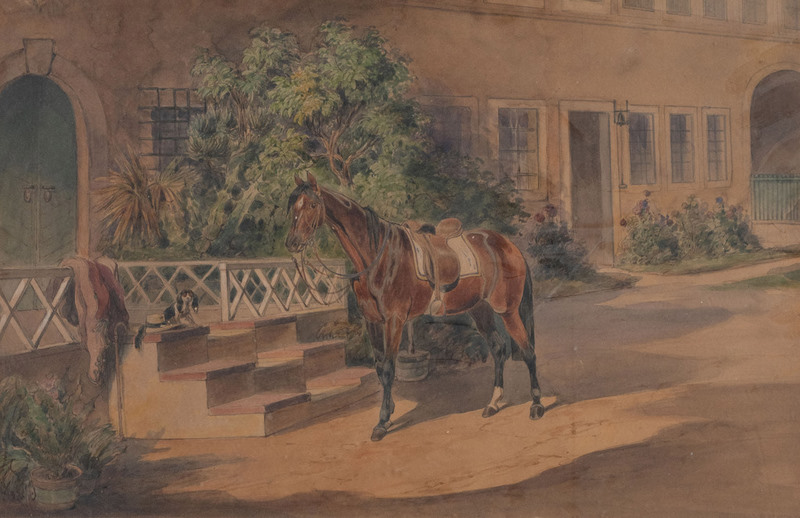
Ladislav Pejačević (?), Horse in Front of the Castle, Fourth Quarter of the 19th Century, paper/watercolours, 32,5 x 50 cm, MG-3075
Foto: Jovan Kliska
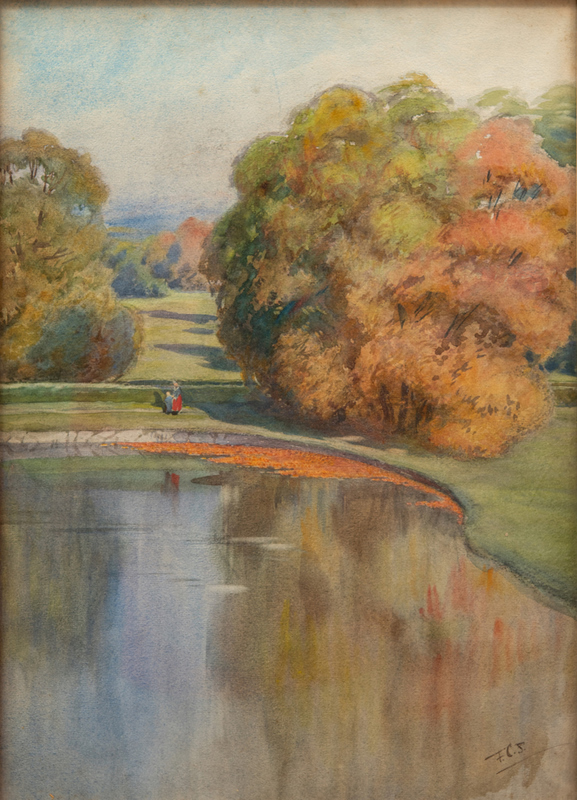
F. C. S. (Franziska Czernin (Schönburg-Hartenstein), Autumn (Landscape with Lake), Early 20th Century, paper/watercolours, 50 x 32,5 cm, MG-3076
Foto: Jovan Kliska
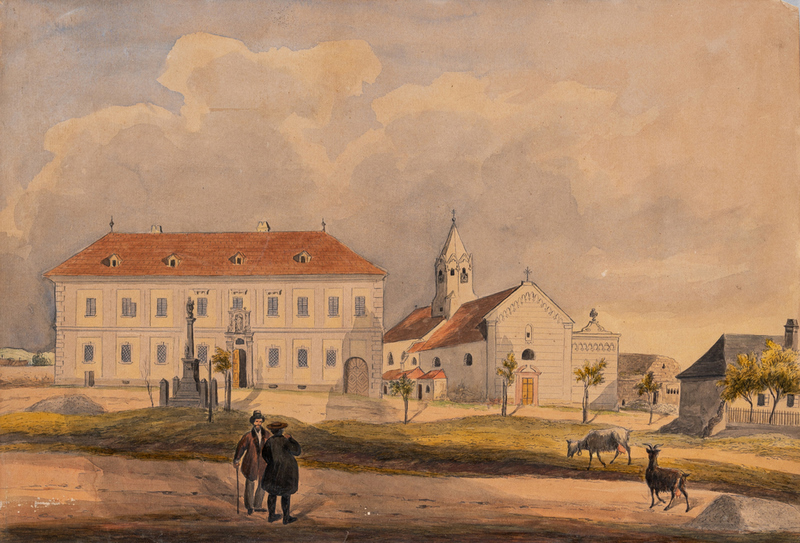
Thomas Ender (?), Architectural Group, 1817–1820, paper/watercolours, 21,5 x 31,4 cm, MG-1850
Foto: Jovan Kliska
Conclusion
Ivana Rončević Elezović, Ph.D
Back to Unattributed and Undated works
Conclusion
The unattributed and undated works in the holdings of the National Museum of Modern Art in Zagreb form a diverse group, created between the 18th century and the first half of the 20th century. Thematically, they have been divided into four main categories: portraiture, landscapes, vedute, and interiors, animal paintings, and a group of other subjects, including sacred painting, still life, the nude, and mythological, genre, and historical scenes. The corpus also includes six exotic examples of Japanese woodcuts. Taken together, the collection provides a representative cross-section of bourgeois culture in Zagreb during the 19th century and early 20th century, encompassing Biedermeier, Romantic, and Realist works, as well as early modern paintings with a marked tendency towards simplified forms. Examining the collection also offers a cultural and socio-anthropological view of bourgeois life in Zagreb and Europe during the period, revealed through themes, styles, depicted settings, and the stories behind the paintings. For example, the initially unattributed and undated watercolours Architectural Group (MG-1850) and Street View with Figures (MG-1851) take the observer on a historical journey, touching on the Austrian Expedition to Brazil, Prince Metternich, the Congress of Vienna (1814–1815), and the geostrategic realignments of the great powers, as well as the everyday lives and relationships of Croatian noble families, including their affection for animals, illustrated in the backstory of Horse in Front of the Castle (MG-3075). The collection also illuminates the history and gradual emancipation of women painters, particularly noblewomen, as exemplified by Autumn (Landscape with Lake) (MG-3076).
The painting materials have been meticulously examined by the team, producing detailed notes and extensive photographic documentation. A long-term project for the complex restoration of these neglected works has been ongoing for four years and will continue beyond the exhibition opening. These challenging restorations require close collaboration between the NMMU conservation team and a range of external specialists. The project also includes the preparation and publication of restoration reports. Selected reports are presented at the exhibition opening, including those by NMMU restorators-conservators Marija Kalmeta and Sonja Pavin, and links to reports by Iva Galijan and Kali Radojlović[77] from the Academy of Fine Arts in Zagreb. Further reports will continue to be published on the exhibition website, as this project is regarded as a work in progress.
The examined material comprises a substantial number of works of solid quality. In the course of our study, we were able to uncover new documentary information, including precise dates and possible attributions, for nearly a third of the 58 exhibited works. Each work has been assigned at least an estimated date, and their stylistic and iconographic analyses, along with provenance research based on the National Museum of Modern Art’s records, have been presented. Altogether, this provides a strong foundation for further research into this intriguing and challenging subject.
Footnotes
[77] In the meantime, conservator-restorer Marija Kalmeta has transferred from the NMMU to the Croatian Conservation Institute in Zagreb.