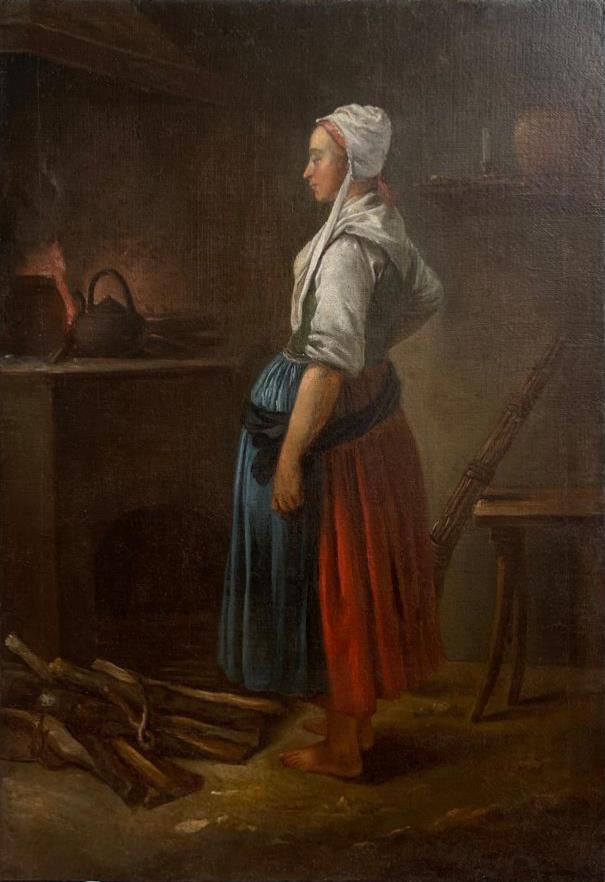
Anon., Woman in the Kitchen, 18th Century, oil/canvas, 81 x 56 cm, MG-3042
Foto: Jovan Kliska
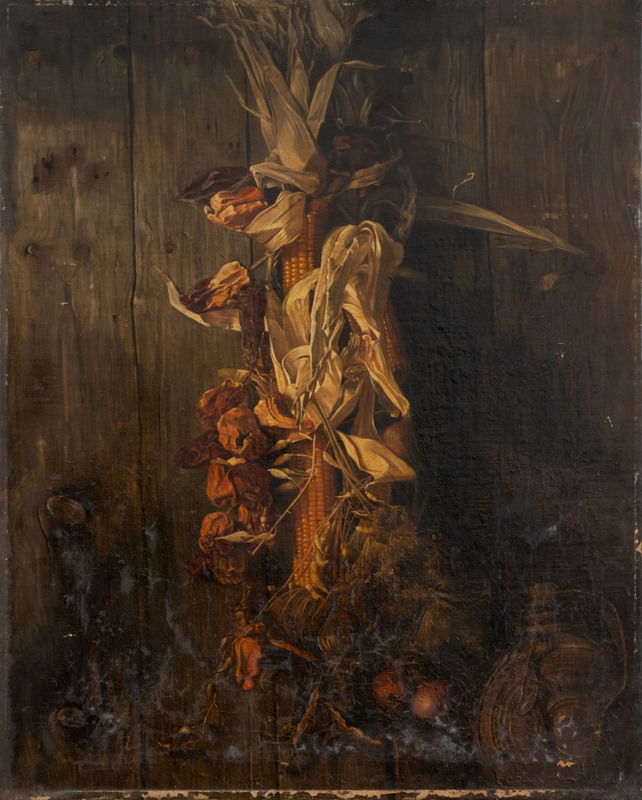
Izidor Kršnjavi (?), Still Life with Corn, Fourth Quarter of the 19th Century, oil/canvas, 61 x 77,5 cm, MG-2782
Foto: Jovan Kliska
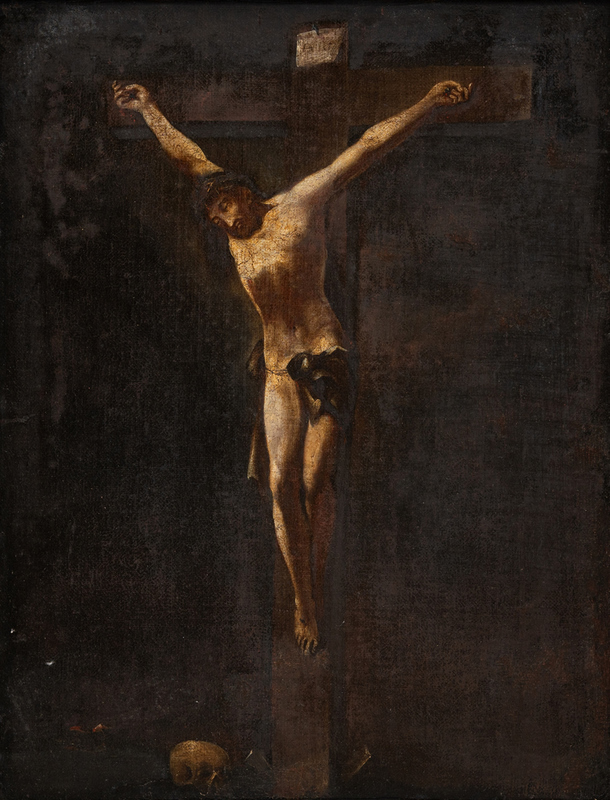
Anon., Christ on the Cross, 18th Century (?), oil/cardboard, 58,5 x 46 cm, MG-2117
Foto: Jovan Kliska
Other Themes
Ivana Rončević Elezović, Ph.D
Back to Unattributed and Undated works
Other Themes
Other subjects represented in this group of unattributed and undated paintings include religious works, mythological scenes, still lifes, nudes, historical paintings, and genre scenes. Still Life (MG-3151), tentatively dated to the 18th century, formally belongs to the still-life genre. Conceptually, however, it serves as a memento mori allegory, reminding us of the fleeting nature of earthly life and the impermanence of material and worldly possessions. A closer iconographic analysis reveals that the allegory is Christian in nature, and the painting is accordingly classified among religious, sacred works. In fact, the two skulls clearly refer to the first humans, Adam and Eve, while the bitten apple and serpent warn that their death and decay are the consequences of sin. On the reverse of the canvas are labels inscribed F. E. Hinz / (monogram) 30. The work was previously recorded in the KOMZA register under inventory number 1796 and was entered into the inventory of the then Modern Gallery based on the Gallery Board Decision No. 86/1-73, dated 23 April 1973.[63]
The sacred painting Christ on the Cross (MG-2117), likely dating to the 18th century, is similarly executed in a solid, accomplished style. As in the previously analysed work, a dark palette predominates, with dramatic contrasts highlighting the central motif in a Baroque theatrical manner: the crucified Christ, a skull at the foot of the cross, and the inscription INRI above.[64] The skull, almost invariably placed at the foot of the cross, carries a dual symbolic significance. The first allusion is to the site of Christ’s Passion, the hill outside Jerusalem where, according to the Bible, he was crucified: Golgotha, or Calvary in Latin. The name Golgotha derives from the Aramaic gulgulta, meaning “skull,” as the rocky contours of the hill may have resembled a skull; it was also an execution site in antiquity. The second allusion is to Adam’s skull, since Christ’s crucifixion symbolises the redemption of humanity from Adam’s original sin, inherited by all mankind.
During the preparatory review of materials for this exhibition, museum adviser Dajana Vlaisavljević suggested that Still Life with Corn (MG-2782), tentatively dated to the last quarter of the 19th century, may be the work of Izidor Kršnjavi (1845–1927). In style, technique, and subject matter, the painting closely resembles two of Kršnjavi’s 1874 still lifes, composed as hanging garlands, now known only from glass negatives taken by an unknown photographer and held in a private collection.[65] This attribution is further supported by the painted background of upright wooden boards, identical to those in Kršnjavi’s compositions. The correspondence of all these details makes the attribution of the painting to Kršnjavi quite plausible. It features a symmetrical composition in dark tones, with lighter brown and beige hues accentuating the central motif, executed in a solid style of academic realism characteristic of the last quarter of the 19th century, devoid of allegorical meaning. The composition follows the conventions of academic still life, commonly seen in depictions of hanging game, often hunting trophies, such as Miroslav Kraljević’s (1885–1913) Wild Ducks (1910), also in the collection of the National Museum of Modern Art, or Nikola Mašić’s (1852–1902) Still Life – Wild Ducks, s. a. The painting was previously recorded in the storage register under number MGP-800 and was formally transferred to the ownership of the then Modern Gallery on 20 February 1970 by Mrs Elza Rukavina under Gift Agreement No. 91/2-1970.[66]
Among the examined artworks, a notable number belong to the tradition of genre painting, portraying scenes from the daily lives of the nobility, the bourgeoisie, and ordinary people. Although present throughout the history of painting, genre subjects gained particular prominence in Dutch Baroque art, from where the fashion spread across Europe, especially during the 19th century. Like landscape painting, they played a key role in the democratisation of art, affirming so-called minor subjects as pictorial themes of equal standing with the grand, representative painting. The spread of this tradition across Europe is exemplified by the Bamboccianti, a group of painters active in Rome from around 1625 until the late 17th century. They were painters of pastoral and genre scenes, mainly Dutch and Flemish, who introduced into Italy the established Netherlandish tradition of rural imagery dating back to the 16th century. They generally produced small-scale works depicting the daily lives of Rome’s lower classes and the peasantry of its surrounding countryside, with familiar motifs such as food and drink vendors, farm workers, milkmaids, soldiers at leisure, beggars, and the like. Though rooted in humble subject matter, these paintings enjoyed wide popularity and fetched solid prices. Their enduring appeal is evident in the notable number of unattributed and undated genre scenes preserved in the collection of the National Museum of Modern Art.
The first painting that, despite its lofty title, fits into this category is Historical Scene (MG-3034), probably dating from the 18th century based on its style. It was entered into the National Museum of Modern Art inventory based on the Gallery Board Decision No. 86/1-23, dated 23 April 1973, transferred from the KOMZA Register, where it had been listed as entry number 6.[67] A notable work from the same period, Young Couple with Two Dogs (MG-3035), was added to the NMMU Inventory Book based on the same decision.[68] This conclusion is supported by the figures’ costumes, the 18th-century painting technique, and the Rococo taste for ornamentation, evident in the “dancing” brushwork that imparts vitality and movement. The small oil-on-tin painting Woman Reading (MG-3037), set in a substantial gilded frame with richly embossed decoration, is also assignable to the 18th century. On the reverse is a silver medallion inscribed Sabor NRH / BR. 17 88, suggesting the work was once housed in the premises of the Parliament of the People’s Republic of Croatia. It was also entered into the inventory of the National Museum of Modern Art based on the Gallery Board Decision No. 86/1-23, dated 23 April 1973, having been transferred from the KOMZA Register, where it was listed as entry number 27.[69] Woman in the Kitchen (MG-3042) is also attributed to the 18th century.[70] It was carefully restored by conservator-restorer Kali Radojlović at the Academy of Fine Arts in Zagreb, who prepared a detailed report documenting the entire process.[71] The painting shows a standing female figure in profile within a dimly lit kitchen and belongs to the tradition of domestic interiors, particularly scenes centred on the kitchen (gatherings around the hearth). European painting has long favoured intimate domestic scenes, particularly during the Baroque period and continuing into the 19th century. Examples include the Italian brothers Domenico and Gerolamo Induno (1815–1878; 1825–1890), the Macchiaioli and Resina painters such as Silvestro Lega (1826–1895), Odoardo Borrani (1833–1905), and Adriano Cecioni (1836–1886), as well as their influence on Domenico Pesenti (1843–1918) and Giovanni Muzzioli (1854–1894), extending to Croatian painter Vinko (Vicko) Marija Draganja (1856–1926). In Woman in the Kitchen, selected details function as miniature still lifes within the scene.
Family Scene around the Cradle (MG-3053), reflecting the Biedermeier focus on family life, is dated to the first half of the 19th century. It was entered into the National Museum of Modern Art Inventory Book based on the Gallery Board Decision No. 86/1-23, dated 23 April 1973, transferred from the KOMZA Register, where it had been listed as entry number 134.[72] Similarly, Tavern Scene (MG-3077) had previously appeared in the KOMZA Register as entry number 332.[73] The latter painting depicts a scene from everyday life in the Dutch and Flemish tradition, as brought to Italy by the Bamboccianti. With a Breughelian touch in both atmosphere and composition, its lively tavern scene featuring figures from the lower classes is dated to the mid-19th century.
Still Life (Flowers) (MG-2784) probably dates from the early 20th century. Previously recorded in the Storage Book as MGP-803, it was donated to the National Museum of Modern Art by Mrs Elza Rukavina under a gift agreement.[74] It is characteristic of the early 20th-century in its atmosphere, with a painting style that shows a slightly rigid modelling and a sentimental portrayal of a colourful bouquet, with predominantly red, pale pink and white flowers, spilled from a basket and spread out before the observer.
Among the works examined, two depictions of women in daily life stand out for their high artistic quality and relatively recent date. The first, which we date to the second quarter of the 20th century based on style, shows an elderly woman in black with a headscarf, seated full-length in three-quarter profile within a peasant kitchen. Signed in the lower left corner with the initial A. (MG-3133), it is a modern take on the tradition of depicting women at domestic tasks, as discussed earlier. The painting is marked by a confident, reductive, sketch-like approach and a masterful detail of casually draped white-and-red striped fabric in the background, adding freshness to the scene. The oil technique here produces a deliberately light, almost watercolour-like effect, demonstrating the painter’s skill. The work was entered into the National Museum of Modern Art Inventory Book based on the Gallery Board Decision No. 86/1-23, dated 23 April 1973, having been transferred from the KOMZA Register as entry number 1649.[75] The second work, Girl with a Bird (1955, MG-6365), executed on paper in a wash ink technique, shows a delicate, standing young girl holding a bird. Its stylised, elongated forms and translucent washes create an airy sense of refined elegance and lyrical purity. On the reverse is a label reading: Custom frames by Abbott Picture Framers (…) Wisconsin Ave. N.W., Georgetown, Washington D.C. The lower left corner on the front bears the signature Fenaris Paris 55. These markings indicate that the work was painted in Paris in 1955 and later framed in the United States. The name Fenaris does not give us much to go on, as the artist remains unidentified, about whom no information appears to exist. Museum records confirm that the painting entered the collection as part of the estate of Mrs Melita Pešelj of Washington.[76]
Footnotes
[63] NMMU Museum Documentation, Inventory Book, Book II (from MG-3000 to MG-6937), 1973, 1–520, 16.
[64] Iesus Nazarenus Rex Iudaeorum – Jesus of Nazareth, King of the Jews.
[65] See: Dajana Vlaisavljević, “Slikarstvo Ise Kršnjavoga,” in: Slikar Iso Kršnjavi. Čovjek svoga vremena, exhibition catalogue, (ed.) Margareta Legiša, Zagreb: Izidor Kršnjavi Exhibition Salon – School of Applied Arts and Design, 1993, 15–19, 17; Iso Kršnjavi, veliki utemeljitelj. Ministar europskog duha, exhibition catalogue, (ed.) Ana Filep, Zagreb: Croatian History Museum, 2012, 74, 75.
[66] NMMU Museum Documentation, Inventory Modern Gallery “Storage,” 1–200, 82; NMMU Museum Documentation, Inventory Book, Book I (from MG-1 to MG-2999), 1–280, 260.
[67] NMMU Museum Documentation, Inventory Book, Book II (from MG-3000 to MG-6937), 1973, 1–520, 4.
[68] In the KOMZA Register, the painting was previously listed under entry number 26, NMMU Museum Documentation, Inventory Book, Book II (from MG-3000 to MG-6937), 1973, 1–520, 4.
[69] NMMU Museum Documentation, Inventory Book, Book II (from MG-3000 to MG-6937), 1973, 1–520, 4.
[70] Kali Radojlović, Conservation-Restoration Treatments of the Painting “Woman in the Kitchen” from the National Museum of Modern Art, Zagreb (Master’s Thesis). Zagreb: University of Zagreb, Academy of Fine Arts (2024), 1–122, 10–12. Available at: https://urn.nsk.hr/urn:nbn:hr:215:555042
[71] Ibid, 1–122.
[72] NMMU Museum Documentation, Inventory Book, Book II (from MG-3000 to MG-6937), 1973, 1–520, 6.
[73] Ibid, 8.
[74] NMMU Museum Documentation, Inventory Modern Gallery “Storage,” 1–200, 82; NMMU Museum Documentation, Inventory Book, Book I (from MG-1 to MG-2999), 1–280, 261.
[75] NMMU Museum Documentation, Inventory Book, Book II (from MG-3000 to MG-6937), 1973, 1–520, 14.
[76] Isto, 335.