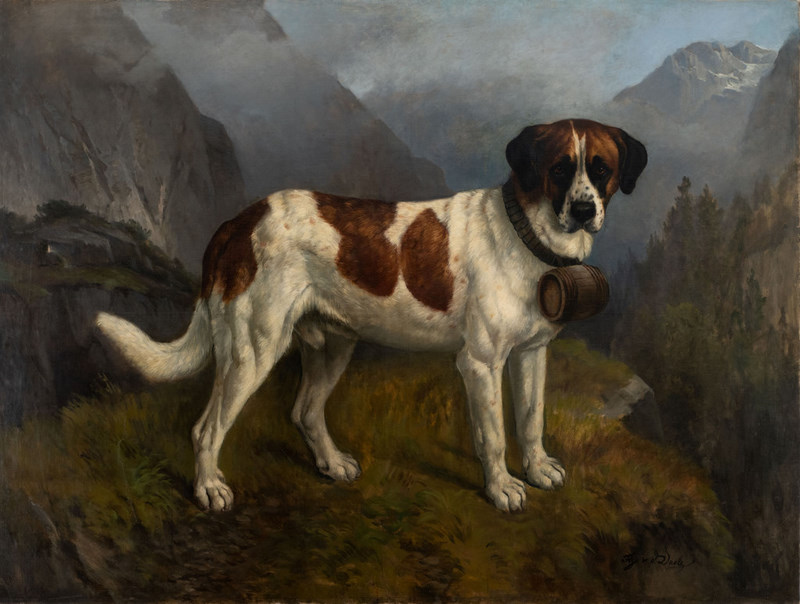
Anon., Dog, Fourth Quarter of the 19th Century, oil/canvas, 200 x 151 cm, MG-3033
Foto: Jovan Kliska
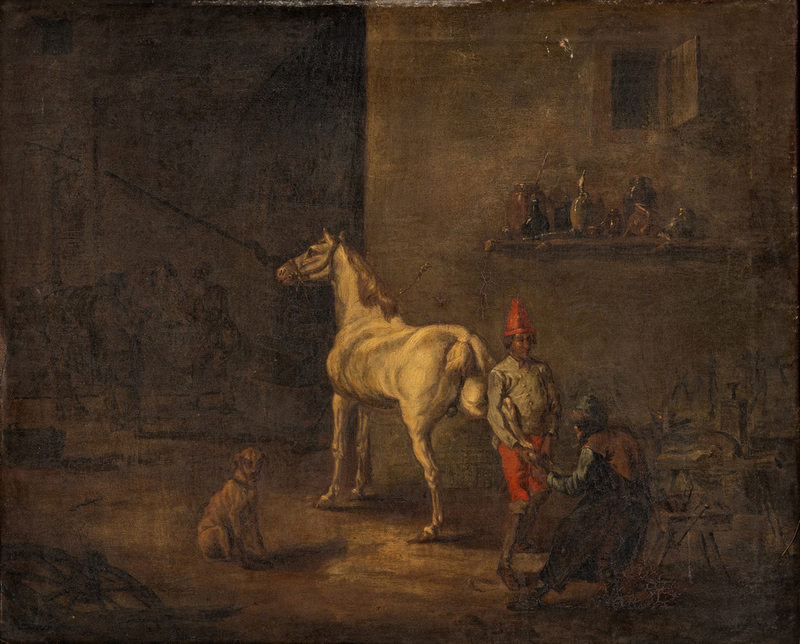
E. Ch. Müller, In the Smithy, 19th Century, oil/canvas, 69 x 48 cm, MG-3038
Foto: Jovan Kliska
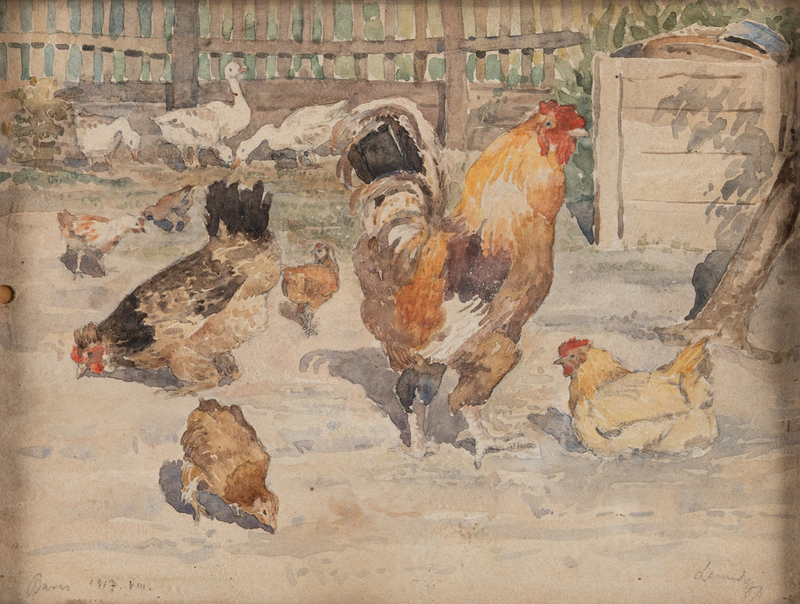
Anon., Poultry in the Courtyard, August, 1917., paper/watercolours, 18,3 x 24,2 cm, MG-1855
Foto: Jovan Kliska
Animal Painting
Ivana Rončević Elezović, Ph.D
Back to Unattributed and Undated works
Animal Painting
The representation of animals in visual art dates back to its earliest beginnings: from prehistoric paintings with a magical function, through ancient mythologies that created chimeras, minotaurs, and centaurs, to classical portrayals of the animal world in Western art, whether within portraits, genre scenes, historical or landscape compositions, or as independent subjects in modern painting. The collection of unattributed and undated works in the holdings of the National Museum of Modern Art, also includes several accomplished depictions of animals.[49] The examples we have examined are predominantly in the Central European artistic traditions of the Munich and Vienna schools.[50]
This is particularly apparent in the painting Dog (MG-3033) by an unknown artist, which, based on its style, we date to the last quarter of the 19th century. It is a highly accomplished large-scale animal portrait set within a mountain landscape. The animal is rendered with striking realism, its posture and size conveying a commanding presence, further emphasised by the grandeur of the surrounding scenery. By depicting the body in profile while turning the head and directing its gaze towards the observer, the artist establishes a sense of interaction between the animal and the audience. The painting was entered into the Inventory of the National Museum of Modern Art via the KOMZA Book (listed as number 5), based on the Gallery Board Decision No. 86/1-73, dated 23 April 1973.[51]
The exotic scene Tropical Landscape (MG-3047), likely dating to the mid-19th century, is rendered in a masterful naturalistic style, with meticulous detailing of exotic plant and animal species in emerald, blue, and brown tones, highlighted by occasional touches of red. It was also formerly listed in the KOMZA Book (entry no. 96).[52]
This group of works features an especially large number of horse paintings. Horses appear within genre scenes, as seen in In the Smithy (MG-3038) and In Front of the Horse Stable (MG-3061). In the Smithy suggests either an earlier date or a 19th-century emulation of 18th-century genre painting. The composition presents elongated figures in dark tones, with the central focus on a white horse being shod and the vivid red of the man’s clothing as he lifts its leg. A seated dog is also depicted in the lower left corner, its gaze meeting that of the observer. In the upper left half of the painting, black outlines reveal an obviously unfinished depiction of another horse standing, held by a figure at the reins. A metal plaque affixed to the central lower bar at the front of the frame bears the work’s title in Croatian and a tentative attribution to E. Ch. Müller, an otherwise unknown artist. Stylistically, In Front of the Horse Stable is dated to the latter half of the 19th century. The scene portrays a group of men in flamboyant dress, wearing tall top hats, accompanied by a horse in the landscape before the stable, either preparing for or returning from a ride. Of particular interest is the central lower bar at the front of the gilded frame, which bears the word HAP HAZARD in relief. Originally, in English, it was synonymous with the adjective “accidental,” but it later came to denote a condition in which things are scattered without apparent order or logic. Both paintings were transferred to the inventory of the National Museum of Modern Art from the KOMZA register, where In the Smithy was listed as number 29 and In Front of the Horse Stable as number 190.[53]
Horse in Front of the Castle (MG-3075) was probably painted in the last quarter of the 19th century. This exquisite watercolour, rendered in a realistic style with washes of azure, shows at its centre a standing horse with a lively gaze directed towards the observer. In the left half of the composition, a black-and-white puppy is depicted in front of an architectural fragment of the castle façade, with hints of garden vegetation.[54] A label on the reverse indicates that the painting was mounted in Vienna (C. Bühlmayer / K. k. Hof-Vergolder / I. Michaeler Durchhaus, Mariahilfer Strasse 45, Wien).[55] An extensive German inscription on the back reveals that the horse, likely named Ali, was purchased in 1845 in Ruma by Hugo II, Count von und zu Eltz (1817–1848), on the Pejačević family estate in Syrmia. After 1848, the painting came into the possession of Ladislav the Younger, Count Pejačević (1828–1916), who received it as a gesture of courtesy from a count in Vukovar. The dog depicted, possibly named Pinč (?), belonged to Sophie, Countess von Schönborn-Wiesentheid, née Countess zu Eltz (1814–1902), who most likely presented it to Ludvina, Countess Eltz, née Pejačević (1826–1889). The horse Ali is shown standing before an exterior terrace belonging to Dr. (illegible) in Vukovar. The painting was given as a gift from Count Pejačević to Countess Pejačević, as recorded in Vukovar in 1906.[56] According to Silvija Lučevnjak, director of the Našice Local History Museum, housed in the Pejačević family castle and a specialist in Slavonian noble history, “these are relatives, the Eltz family of Vukovar and the Pejačevićs of the Ruma–Retfala branch, and this is their famed stud farm in Ruma.”[57] Furthermore, with Ms Lučevnjak’s assistance, we were able to possibly identify the painter as Ladislav, Count Pejačević, an amateur artist whose work has been discussed in detail by Jasminka Najcer Sabljak and Đorđe Bošković.[58]
Two Horses (MG-3124), executed in an early 20th-century realist style, is characterised by free, visible brushstrokes and complementary tonal shading. The painting depicts two brown draft horses standing parallel in a verdant rural setting. It was previously recorded in the KOMZA register under inventory number 1491.[59] An illegible signature appears in the lower left corner, while the reverse of the canvas shows an unfinished oil sketch of a grazing horse. Landscape (MG-3149), from the same period, presents a somewhat more “rigid” realist view of rural life, featuring a man and a woman, a donkey, grazing cows, and oxen in harness within a village setting. The painting was also transferred to the NMMU from the KOMZA register in 1973 (inventory number 1794).[60] Interestingly, visible along the left edge of the composition are early depictions of power lines carrying electricity.
Depictions of chickens and geese were a common feature in Baroque painting as well as in 19th-century genre and landscape traditions. Poultry in the Courtyard (MG-1855), initially thought to have been painted in the early 20th century, confirmed this dating when a close examination revealed an almost illegible pencil signature in the lower left corner (Bares [?]), precisely dated August 1917, supporting the concept of a “long nineteenth century.” The watercolour on paper is executed in a solid realist style, with a central rooster surrounded by hens and white geese, set within the setting of a rural courtyard. Poultry subjects are particularly prominent in the work of Nikola Mašić (1852–1902), with European parallels seen, for example, in the paintings of the Catalan artist Marià Fortuny y Carbó (1838–1874),[61] whose style is closely aligned with Mašić’s. In the National Museum of Modern Art’s Inventory Book, this painting is listed under the heading Entered into the Collection (provenance): MUO (Museum of Arts and Crafts), inventory number 398.[62]
Footnotes
[49] For more on animal painting, see: Dajana Vlaisavljević, Sve naše životinje, exhibition catalogue, (ed.) Lada Bošnjak Velagić, Zagreb: Modern Gallery, 2017.
[50] See, for example: Hans-Peter Bühler, Anton Braith. Christian Mali. Tier maler der Münchner Schule, Mainz am Rhein: Verlag Philipp von Zabern, 1981.
[51] NMMU Museum Documentation, Inventory Book, Book II (from MG-3000 to MG-6937), 1973, 1–520, 4.
[52] It was also entered into the inventory of the then Modern Gallery based on the Gallery Board Decision no. 86/1-73, dated 23 April 1973, Ibid, 5.
[53] They were entered into the inventory of the National Museum of Modern Art based on the Gallery Board Decision no. 86/1-73, dated 23 April 1973, Ibid, 4, 7.
[54] The painting was also transferred to the NMMU from the KOMZA register (inventory number 311) based on the Gallery Board Decision No. 86/1-73, dated 23 April 1973, Ibid, 8.
[55] The framing workshop C. Bühlmayer in Vienna still exists today and has a tradition dating back to 1833.
[56] I am grateful for the assistance with translating the German-language entries to Prof. Asti Car, granddaughter of the long-serving curator of the Museum of Arts and Crafts in Zagreb and art historian Anka Simić-Bulat, PhD (1899–1987). I would also like to thank Prof. Silvija Lučevnjak for her help in providing accurate historical and documentary information regarding the noble families and relationships mentioned in the records.
[57] Email correspondence from Silvija Lučevnjak to Ivana Rončević Elezović, dated 29 August 2025; I am also grateful to Prof. Lučevnjak for her assistance in clarifying the details recorded on the back of Horse in Front of the Castle (MG-3075).
[58] “Ladislav, Count Pejačević, was the last male member of the Ruma–Retfala branch of his family. He resided in Retfala near Osijek and Hadersdorf near Vienna, while also managing the Ruma estate, which he significantly developed economically at the turn of the 19th to the 20th century. Preserved memoirs recount Count Ladislav’s account of the tragic death of his brother-in-law, Hugo, Count Eltz, as well as the uprisings in Syrmia and Slavonia in 1848. His recollections offer valuable insight into the lifestyle of the region’s nobility in the mid-19th century. His modest yet notable body of drawings is documented, alongside his relationship with the Austrian artist Franz Alt, some of whose works were created on the estates of the Pejačević and Eltz families.”, Jasminka Najcer Sabljak i Đorđe Bošković. "Likovna i rukopisna ostavština Ladislava grofa Pejačevića iz Retfale i Rume", in: Scrinia Slavonica, vol. 18, no. 1, 2018, 129-174, 129. https://hrcak.srce.hr/211089 Accessed 4 September 2025; See also: Najcer Sabljak, Jasminka i Silvija Lučevnjak. "Karlo i Ludvina Eltz — nositelji obnove Burga Eltz u 19. stoljeću." Peristil, vol. 60, no. 1, 2017, 61-76. https://doi.org/10.17685/Peristil.60.5. Accessed 4 September 2025.
[59] Entered into the NMMU Inventory Book based on the Gallery Board Decision Np. 86/1-73, dated 23 April 1973, NMMU Museum Documentation, Inventory Book, Book II (from MG-3000 to MG-6937), 1973, 1–520, 13.
[60] Gallery Board Decision No. 86/1-73, dated 23 April 1973, Ibid, 15.
[61] Also known as Mariano Fortuny y Marsal.
[62] NMMU Museum Documentation, Inventory Book, Book I (from MG-1 to MG-2999), 1–280, 173.