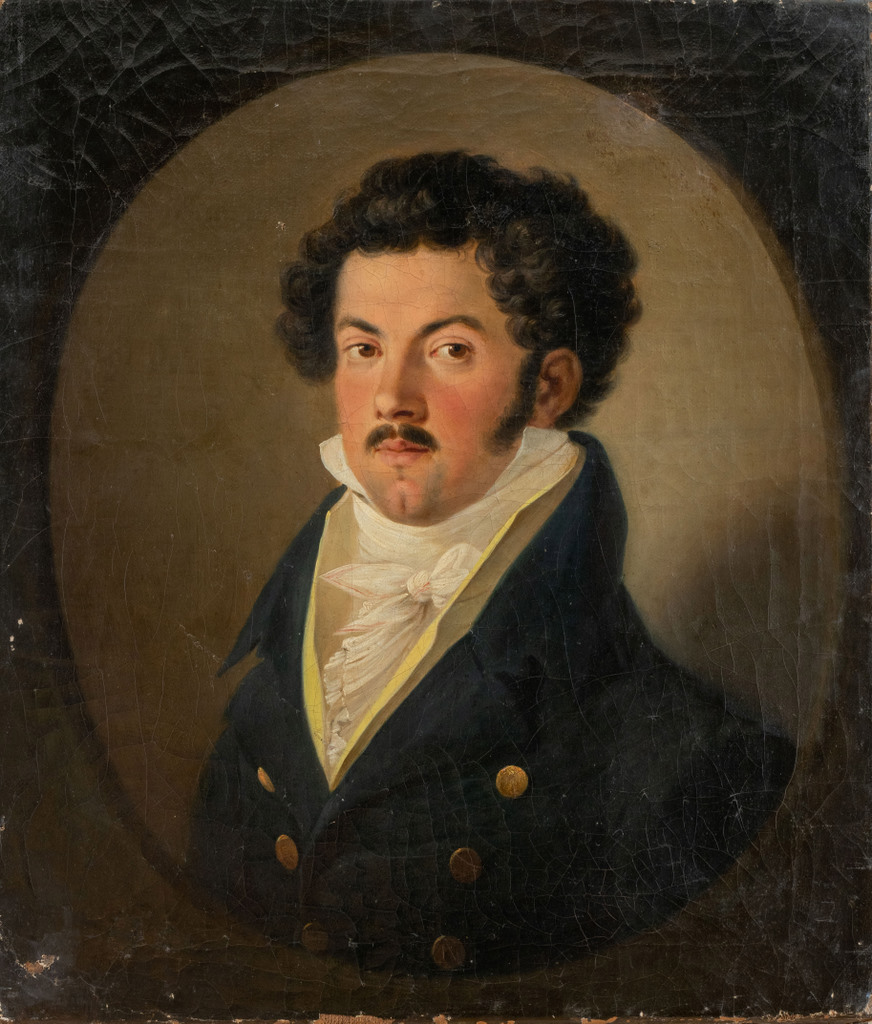
Anon.,Portrait of a Man, First Half of the 19th Century, oil/canvas, 55 x 47,5 cm, MG-57
Foto: Jovan Kliska
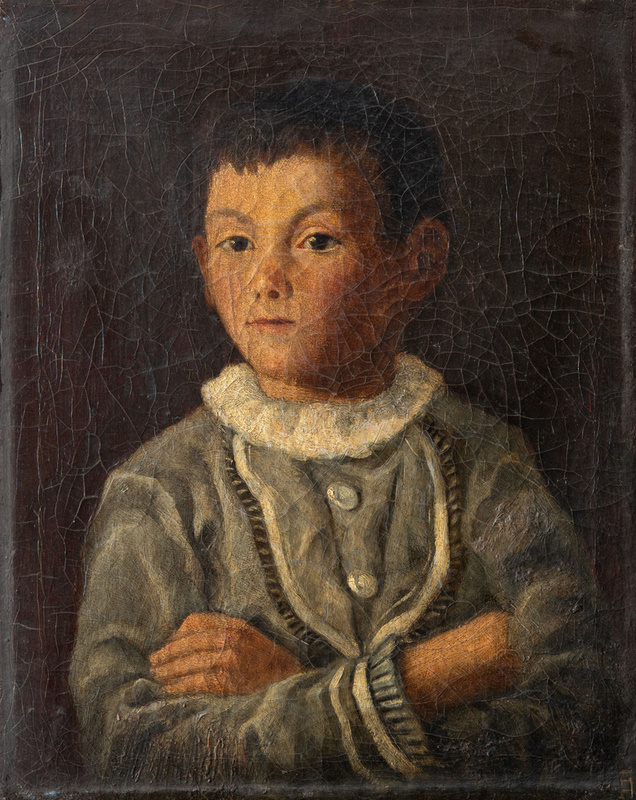
Seethelner, Portrait of a Boy with Crossed Arms, Second Half of the 19th Century, oil/canvas, 43 x 35 cm, MG-53
Foto: Jovan Kliska
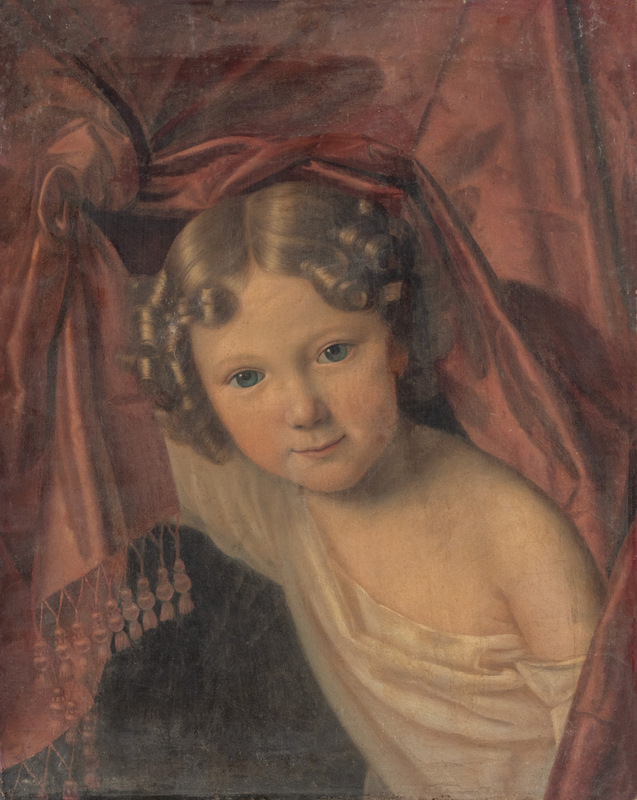
Gustav Poša (Copy of the Work by Ferdinand Georg Waldmüller), Girl Behind a Red Curtain, (Countess Elizabetu Batthyány, married Drašković), 1841, oil/canvas, 45 x 35,5 cm, MG-3073
Foto: Jovan Kliska
Portraiture
Ivana Rončević Elezović, Ph.D
Back to Unattributed and Undated works
Portraiture
Portraiture is the largest of these subcategories, particularly in the Biedermeier style, whose quality was highlighted by Dajana Vlaisavljević in the 1997 exhibition 19th-Century Portraits from the Modern Gallery Holdings.[6] The term Biedermeier, used to describe a Central European artistic style roughly spanning 1815 to 1848, derives from the fictional character Gottlieb Biedermaier, a village schoolteacher in historical Swabia,[7] created by the German lawyer and humorous poet Ludwig Friedrich Eichrodt (1798–1844) and his colleague, the internist and gastroenterologist Adolf Kussmaul (1822–1902).[8] While originally somewhat pejorative, as the character represented a well-meaning petty bourgeois of narrow outlook and submissive, servile mentality, the term has long also been interpreted in a more positive, even emancipatory sense. In fact, Biedermeier was not only a symbol of the emergence and rise of a new bourgeois class, gradually overtaking the aristocracy and signalling a broad transformation of society in line with the technological advances of the modern era, but also developed stylistically in contrast to the lavish, ornate forms of the Napoleonic Empire style. This involved a simplification of form, resulting in pronounced geometrisation suited to more modest bourgeois interiors, while drawing on the Classical forms of late 18th-century England and the style associated with the reign of France’s last king, Louis-Philippe (1773–1850). In this sense, Biedermeier can be regarded as a forerunner of modernist design, emphasising simplicity, clarity, honesty, functionality, and minimalism. Its use of affordable, locally sourced materials in the production of objects of applied arts allowed for wider and more democratic access, reinforcing its connection to modernist ideals. The style found particular expression in applied arts, and in Croatia the term was introduced via Vienna, becoming established in the second half of the 19th century, mainly in reference to the Alt-Wien (Old Vienna) style of bourgeois apartment interiors. In this context, the production of bourgeois portraits increased, serving as symbols of a new social status – subjects once reserved for the nobility and high-ranking church officials. The Biedermeier bourgeois portrait thus became a hallmark of the period, marked by psychological characterisation, pronounced linearity of smooth surfaces, simplified forms, and an intimate atmosphere, often depicting bourgeois interiors and gardens. Among the works examined, many preserved in their original, representative frames, which should be considered integral to the paintings, the Portrait of a Lady (MG-58) stands out for its quality. Dated to the first half of the 19th century, it is particularly notable for its intricate depiction of jewellery, which can be appreciated almost as miniature paintings in their own right.[9] In terms of the sitter’s pose, composition, style, subject, and motifs (jewellery), this painting closely resembles Vjekoslav Karas’s (1821–1858) Portrait of Josipa Dadić (1852–1856), also held in the collection of the National Museum of Modern Art.[10] According to Petra Kursar, MA, senior conservator-restorer at NMMU, the work was restored using a traditional wax restoration technique, with the Inventory Book recording the restoration period as 21 June to 10 August 1949.[11] Also of interest is the miniature Portrait of a Woman by an unknown Dalmatian painter (MG-2030), dated to the same period, for which the limited documentation was obtained from an inscription on the reverse of the painting. Also noteworthy is the outstanding Woman in a Blue Dress (MG-2003), seated on a simple Biedermeier chair with a semicircular backrest, hands folded in her lap, and hair neatly parted in the centre and styled in a bun. The painting features a masterful depiction of the blue drapery, harmonising with the light blue of her expressive eyes, as well as a striking rendering of jewellery and pink-tinged flowering green branches along the right edge. The work was acquired from a private owner for 12,500 dinars at a Gallery Committee meeting on 22 February 1951.[12] In collaboration with the Academy of Fine Arts in Zagreb, organised by Petra Kursar, MA, Head of the Department of Conservation and Restoration at NMMU, the painting was meticulously restored and cleaned by conservator-restorer Iva Galijan. The removal of surface dirt and old varnish revealed the signature Schorn.[13] Galijan proposed that the work may be by the German Neoclassical and Biedermeier painter Karl Schorn (1803–1850).[14] This attribution is supported by a comparison of Woman in a Blue Dress with other works by Schorn, showing a consistent style and a delicate sensitivity in the depiction of female figures. Also notable for its quality is the Portrait of Josip Juraj Strossmayer (MG-54), acquired by the museum from a private owner in 1947 and subsequently restored between 24 July 1949 and 23 December 1952.[15] The painting has been dated to the mid-19th century and is tentatively attributed to Ivan Zasche (1825–1863), a Croatian painter of Czech descent who studied at the Vienna Academy of Fine Arts from 1846 to 1850. Invited by Bishop Juraj Haulik (1788–1869), Zasche settled permanently in Zagreb, where he produced numerous Biedermeier works, including both formal and intimate portraits, miniatures, luminous landscapes, city views, altar paintings, and a series of detailed drawings of traditional costumes from the Lika region. This attribution is further supported by a label on the back of the painting, reading artist: Ivan Zasche (?). The Portrait of Josip Juraj Strossmayer shares stylistic and artistic affinities with Zasche’s well-known Portrait of Ban Josip Jelačić in the Croatian History Museum in Zagreb, painted before 1863, as well as with his Portrait of an Old Man from 1857, both works demonstrating a similarly penetrating psychological character and expressive gaze. The rendering of the folds in the bishop’s cloak and uniform closely resembles the treatment of the dress in Zasche’s Portrait of Julijana Koritić de Mrazovečka from the mid-19th century, both paintings being part of the National Museum of Modern Art holdings.[16] The superior quality of Strossmayer’s portrait is especially apparent when compared with the Portrait of a Dignitary by an unknown artist, dated to the last quarter of the 19th century (MG-3051),[17] which is of a lesser artistic standard; the rendering of the uniform, hands, and facial features appears flatter and less refined. The painting was acquired by the NMMU based on the Gallery Board Decision No. 86/1-73, dated on 23 April 1973, and had previously been listed in the KOMZA Register under entry number 117. [18] While noteworthy, the Portrait of a Lady with a Red Shawl (MG-55) and the Dubrovnik Patrician Woman (MG-2017), the latter entering the NMMU collection as a gift from the Slepčević family,[19] both dated to the first half of the 19th century, along with the Portrait of a Priest from the second half of the 19th century (MG-3068) and the Portrait of Ferdo Rusan (1810–1879), a Croatian amateur musician and composer of marches (MG-45), are of lesser quality, showing awkward proportions, stiff and unrefined modelling, limited sense of depth, and clumsy handling of details and colour. In Rusan’s portrait, a handwritten ink label on the back of the canvas at its centre reads: U 45 godini / života svoga / Rusan Ferdo (At the age of 45 / Rusan Ferdo), enabling the painting to be precisely dated to 1855.[20] The Portrait of a Lady (MG-49), dated to the third quarter of the 19th century, despite some proportional inaccuracies, captivates the observer through the sitter’s expressive gaze, the gentle softness of the flesh tones, and the accomplished depiction of jewellery and the translucent dark green veil on the sleeves.[21]
A distinctive subgenre of Biedermeier portraiture, in keeping with the style’s characteristic mood and ambience, is bourgeois family and children’s portraits. These works often place their subjects in gardens, providing opportunities to depict popular floral motifs, or in the intimate interiors of bourgeois homes, with everyday objects such as toys and other domestic items adding to the sense of daily life.
The first group of family portraits consists of the common practice of portraying spouses side by side, as seen in the well-known portraits of Ana and Miško Krešić, merchants from Karlovac, painted by Vjekoslav Karas between 1852 and 1856, which are also held in the Collection of the National Museum of Modern Art.[22] These paired portraits, of identical dimensions, are usually presented in matching representative frames to highlight their purpose as a unified artistic ensemble. Using the same approach, the collection also includes two high-quality Biedermeier pairs of spouses by unknown artists. The first depicts the Portrait of a Man in an Illyrian Uniform (MG-712), and the second the Portrait of a Lady (MG-729), which is particularly distinguished by the overall quality, attention to detail (again seen in the jewellery, floral motifs [this time in the hair], the treatment of drapery, especially the fur and the translucent veil, the depiction of furniture, and the small notebook with handwritten notes resting on the table that supports the sitter), alongside a notable psychological depth. Based on the painting style and the historical reference to the Illyrian movement, both works are dated to the second quarter of the 19th century, around its midpoint. The portraits are presented in simple, deliberately geometric, matching frames with inlays and highly simplified ornamentation, rectangular on the outside and octagonal towards the painting edge, adapted to the subframe, a feature that, according to Petra Kursar, MA, conservator-restorer at NMMU, is exceptionally rare. On back of the man’s portrait we discovered a note reading, Villa Frapar 1969, while the lady’s is marked Collection Frapar, Lovran, no. 30 / 1968, likely referring to the paintings’ provenance at Villa Frappart in Lovran and their subsequent acquisition by the museum. In the inventory book, the corresponding entries are similarly annotated with Lovran / Villa Frapar or Collection Frapar.[23] Villa Frappart is one of the most beautiful residential villas in Lovran. It was commissioned between 1894 and 1904 by the Viennese lawyer Michel Ruault Frappart (?–?), son of the celebrated Vienna Opera choreographer and dancer Louis Frappart (1832–1921), who was portrayed in a graphic work in 1895 by Menci Clement Crnčić (1865–1930). Together with Franz Gaul (1837–1906), a costume designer at the Vienna Court Opera, Louis Frappart wrote the scenario for the first Croatian ballet, Jela by Bela de Adamović (1856–1934), based on a verse fairy tale by Friedrich Rückert (1788–1866), which premiered at the Croatian National Theatre in Zagreb in 1898. Originally named San Michaele, the villa stood in seclusion. It was designed by Carl Seidl (1858–1936), who frequently worked in Opatija and Lovran at the time, and was awarded a state prize for the project in 1914. On the back of the lady’s portrait, there is also a stamp reading Coller und CAIN Wien, vormalls V. Hall, likely referring to the framing workshop that framed the painting. The other pair of spouses is represented by the Portrait of a Lady and Portrait of a Gentleman from 1880 (MG-6531 and MG-6532), identified through a faintly scratched signature with a date located near the centre of the right edge of the gentleman’s portrait. Although the signature in script is completely illegible, we were able to ascertain the year of creation for both paintings. These Biedermeier portraits are exceptionally well executed, with their later dating reflecting the frequent stylistic delays in 19th-century Croatian art. They are preserved in fine gilt frames with an oval cut-out. The paintings are notable for the masterful portrayal of character, the gentleman’s weary expression and the lady’s pensive gaze, combined with a skilful, almost naturalistic realism. The works were purchased from a private owner in Zagreb for 4,000.00 kuna.[24]
Children’s portraits form a subcategory of Biedermeier bourgeois family portraiture. A particularly fine example is the charming Portrait of a Boy with Crossed Arms (MG-53), painted to chest height, which successfully captures a relaxed posture and a dreamy expression; it has been dated to the second half of the 19th century. On the back of the frame is an old museum label attributing the work to a certain Seethelner, about whom no biographical information is available.[25] Another notable example is the larger group portrait Three Children (from the Stanković Family) (MG-56), dated to the first half of the 19th century. While less accomplished than the previous work, due to stiff poses and slightly awkward proportions, it remains highly impressive as a typical Biedermeier composition set in a garden, complete with flora and fauna (including a white dove held by an older girl dressed in blue). The delightful Girl Behind a Red Curtain (MG-3073), according to a partially legible handwritten note on the back of the canvas in German, is a copy of an original by Ferdinand Georg Waldmüller (1793–1865), the Viennese Neoclassical and Biedermeier painter who greatly influenced 19th-century Austrian and Croatian artists. It depicts the young Countess Elizabeta Batthyány (1820–1882), later married to Count Karl (Dragutin) Drašković (1873–1900), a prominent figure in early Croatian photography, particularly celebrated for his studies of frozen motion captured from multiple angles in the 1894 photograph Stjepan Erdödy’s Leap, which was regularly exhibited in the collection of the Museum of Arts and Crafts in Zagreb.[26] A copy of solid artistic quality, albeit without Waldmüller’s signature virtuosity, was executed in 1841 by Gustav Poša (1825–1900), a Biedermeier painter from Požega known for his distinctive style and oeuvre, as we were finally able to determine after painstaking efforts to decipher the damaged handwritten inscription.[27]
Straddling the boundary between Romantic and Biedermeier expression are two accomplished portraits: the Portrait of a Man (MG-57), dating from the first half of the 19th century and set within an oval frame, and the Portrait of a Maiden (MG-2785) from the mid-19th century, both characterised by their dreamy gazes.[28] This hybrid interplay of Romanticism and Biedermeier is hardly surprising, given that the two stylistic tendencies overlapped chronologically. Romanticism shaped European cultural history from the 1790s through the 1840s, and in contrast to the orderly principles of Classicism, it placed emphasis on the picturesque and the melancholic, on the irrational, the subjective and the transcendent, while fostering a cult of genius, heroism, nature, and the extraordinary.
The shift towards a more modern realism, characteristic of the last quarter of the 19th century, is exemplified in the accomplished and unsentimental Portrait of Adolf Veber Tkalčević (MG-339).[29] Painted with a divisionist technique of fine, hatched strokes, it generates a vibrant surface, a feature typical of Central European painting with Symbolist inclinations at the turn of the 20th century. In contrast, the Portrait of Count Julije Janković (MG-47), executed in a more refined yet equally skilful realist manner and probably dating from the 1830s, despite a doubtful inscription on the reverse indicating 1859 (?), retains elements of Romantic sentimentality in its composition, expression, and characterisation.[30]
Also noteworthy are two Art Deco portraits: the Portrait of a Lady (MG-1189),[31] broadly dated to the early 20th century, and the Portrait of a Man (MG-3079). The latter includes a faint handwritten German inscription in the lower left corner, dedicated to Princess Sophie with deepest respect and signed, it seems, by the donor, Walth. Illser (?). This note provides a precise date of execution: 18 July 1919.[32] Typical of 1920s and 1930s popular portraiture, these pastel-on-paper works convey a light, airy quality in keeping with the spirit of the “Roaring Twenties.” In style, technique, and mood, they are akin to the portraits of Otto Antonini (1892–1959), shown in the NMMU’s 2020 exhibition.[33] They capture the era’s ethos – the Hollywoodisation of artistic expression and a lifestyle approached as a form of escapism, caught between underlying crises and superficial spectacle during the interwar years. In contrast, the art of the Zemlja group and the photography of Tošo Dabac document the social realities of the time, depicting poverty, rural life and urban periphery, and the lives of those on the margins of society.
The painting Head (MG-3136), likely from the early 20th century, shows clear avant-garde influences.[34] The striking composition, a head depicted in three-quarter profile up to the neck, beneath a tilted hat that casts a dramatic, almost expressionistic shadow over the mask-like face, particularly the eyes, serves as a highly suggestive expressive device. The impact is heightened by the formal and chromatic simplification of the palette, against which the red scarf at the neck, the bright whites of the man’s eyes locked on the observer, and the limited light behind him stand out in sharp contrast, placing the figure in intense backlight.
The Portrait of Andrija Milčinović (1877–1937) (MG-2317), The Portrait of Andrija Milčinović (1877–1937) (MG-2317), likely painted around the mid-20th century, is notable for its reductive style and chromatic expressionism, with bold, sweeping brushstrokes and an intense colour palette. It is highlighted here as a meaningful homage to our profession, depicting one of the first curators of the Zagreb Museum of Arts and Crafts. Milčinović, a Croatian writer and art critic, is also remembered for his 1902 psychological novella Nejačići (The Weaklings), which evocatively traces the fate and tragedy of the Croatian intellectual – a figure doomed to defeat despite his talents.[35]
Footnotes
[6] Dajana Vlaisavljević, Slikarski portreti 19. stoljeća iz fundusa Moderne galerije, exhibition catalogue, Zagreb: Modern Gallery, 1997, 3.
[7] Southwest Germany
[8] This refers to a cycle of Biedermeier songs, Liederlust, published in the satirical Munich periodical Fliegende Blätter in 1850.
[9] The painting was restored using a traditional wax technique under the supervision of Petra Kursar MA, senior conservator-restorer and head of the Department of Conservation and Restoration at NMMU.
[10] NMMU Museum Documentation, Catalogue Sheets by Artists – Digital Database Modulor / M++: Vjekoslav Karas, Portrait of Josipa Dadić, 1852–1856, MG-74.
[11] NMMU Museum Documentation, Inventory Book, Book I (from MG-1 to MG-2999), 1–280, 6.
[12] Ibid, 187.
[13] Iva Galijan, Conservation-Restoration Treatments of the Easel Painting “Woman in a Blue Dress”, by an Unknown Artist, from the National Museum of Modern Art, Zagreb (Master’s Thesis). Zagreb: University of Zagreb, Academy of Fine Arts (2024). Available at: https://urn.nsk.hr/urn:nbn:hr:215:768649
[14] Ibid, 12.
[15] NMMU Museum Documentation, Inventory Book, Book I (from MG-1 to MG-2999), 1–280, 6; NMMU Museum Documentation, Catalogue Sheets by Artists – Digital Database Modulor / M++: N.N. / Ivan Zasche (?), Portrait of Josip Juraj Strossmayer, mid-19th century, MG-54
[16] NMMU Museum Documentation, Catalogue Sheets by Artists – Digital Database Modulor / M++: Ivan Zasche, Portrait of an Old Man, 1857, MG-64; NMMU, NMMU Museum Documentation, Catalogue Sheets by Artists – Digital Database Modulor / M++: Ivan Zasche, Portrait of Julijana Koritić de Mrazovečka, mid-19th century, MG-66
[17] On the back of the painting, the central stretcher bar of the wooden support bears a handwritten inscription: Savski Marof, NMMU Museum Documentation, Catalogue Sheets by Artists – Digital Database Modulor / M++: N. N., Portrait of a Dignitary, fourth quarter of the 19th century, MG-3051
[18] NMMU Museum Documentation, Inventory Book, Book II (from MG-3000 to MG-6937), 1973, 1–520, 6.
[19] NMMU Museum Documentation, Inventory Book, Book I (from MG-1 to MG-2999), 1–280, 188.
[20] NMMU Museum Documentation, Catalogue Sheets by Artists – Digital Database Modulor / M++: N. N., Ferdo Rusan, mid-19th century, MG-45; Portrait of a Priest (MG-3068) was added to the NMMU inventory based on the Gallery Board Decision No. 86/1-23, dated 23 April 1973. It had earlier been listed in the KOMZA Register under number 116, NMMU Museum Documentation, Inventory Book, Book II (from MG-3000 to MG-6937), 1973, 1–520, 7.
[21] In the NMMU inventory book, the entry for this painting is recorded as KOMZA 358/47-5.66, NMMU Museum Documentation, Inventory Book, Book I (from MG-1 to MG-2999), 1–280, 5.
[22] NMMU Museum Documentation, Catalogue Sheets by Artists – Digital Database Modulor / M++: Vjekoslav Karas, Portrait of Ana Krešić, 1852–1856, MG-77; NMMU Museum Documentation, Catalogue Sheets by Artists – Digital Database Modulor / M++: Vjekoslav Karas, Portrait of Miško Krešić, 1852–1856, MG-78.
[23] NMMU Museum Documentation, Inventory Book, Book I (from MG-1 to MG-2999), 1–280, 67, 68.
[24] NMMU Museum Documentation, Inventory Book, Book II (from MG-3000 to MG-6937), 1973, 1–520, 352.
[25] The painting was previously restored using an antiquated wax technique and now requires modern conservation treatment, Petra Kursar, MA, Senior Conservator-Restorer at NMMU, Head of the Department of Conservation and Restoration.
[26] Museum of Arts and Crafts, Zagreb (hereinafter MUO), Museum Documentation, Artist Catalogue Sheets – Digital database: Karlo (Dragutin) Drašković, Count Stjepan Erdödy’s Leap, 1894, MUO-044370; Karlo (Dragutin) Drašković, Count Stjepan Erdödy’s Leap, 1894, MUO-044369
[27] The painting was added to the NMMU inventory based on the Gallery Board Decision No. 86/1-23, dated 23 April 1973. It had earlier been listed in the KOMZA Register under number 240, NMMU Museum Documentation, Inventory Book, Book II (from MG-3000 to MG-6937), 1973, 1.–520, 8.
[28] Portrait of a Man (MG-57) was restored between 16 March and 12 November 1953, NMMU Museum Documentation, Inventory Book, Book I (from MG-1 to MG-2999), 1–280, 6; Portrait of a Maiden (MG-2785) was donated to the National Museum of Modern Art by Ms Elza Rukavina from Zagreb, through Donation Agreement No. 91/2 dated 20 February 1920, NMMU Museum Documentation, Inventory Book, Book I (from MG-1 to MG-2999), 1–280, 261.
[29] On the back of the painting, affixed to the stretcher, is a label indicating the workshop mark: J. Lowy / Ecke Weihburggasse. Badberger Strasse nr. 15 / K, K. Hof-Photograph / Wien / K. K. Gartenbaugesellechaft.
[30] The painting was restored during the period from 16 March to 12 November 1953, NMMU Museum Documentation, Inventory Book, Book I (from MG-1 to MG-2999), 1–280, 5.
[31] A corresponding note for this catalogue entry is also recorded in the Inventory Book under KOMZA T-47-7, NMMU Museum Documentation, Inventory Book, Book I (from MG-1 to MG-2999), 1–280, 67, 111.
[32] I am grateful for the assistance with translating the German-language entries to Prof. Asti Car, granddaughter of the long-serving curator of the Museum of Arts and Crafts in Zagreb and art historian Anka Simić-Bulat, PhD (1899–1987).; The painting was added to the NMMU inventory based on the Gallery Board Decision No. 86/1-23, dated 23 April 1973. It had earlier been listed in the KOMZA Register under number 342, NMMU Museum Documentation, Inventory Book, Book II (from MG-3000 to MG-6937), 1973, 1–520, 8.
[33] Ivana Rončević Elezović, Dvije slike Otta Antoninija u fundusu Moderne galerije, Zagreb, exhibition catalogue, (ed.) Ivana Rončević Elezović, Zagreb: Modern Gallery, 2020.
[34] The painting was added to the NMMU inventory based on the Gallery Board Decision No. 86/1-23, dated 23 April 1973. It had earlier been listed in the KOMZA Register under number 1664, NMMU Museum Documentation, Inventory Book, Book II (from MG-3000 to MG-6937), 1973, 1–520, 14.
[35] On the reverse of the painting, rendered in the same style, is a modernist still life showing a modest meal on a tin plate, set within a deliberately cropped view of a chair.