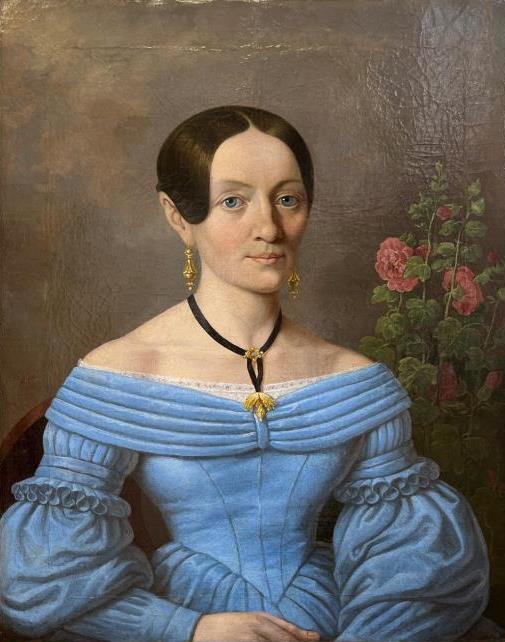
Karl Schorn (?), Woman in a Blue Dress, First Half of the 19th Century, oil/canvas, 66 x 53 cm, MG-2003
Foto: Jovan Kliska
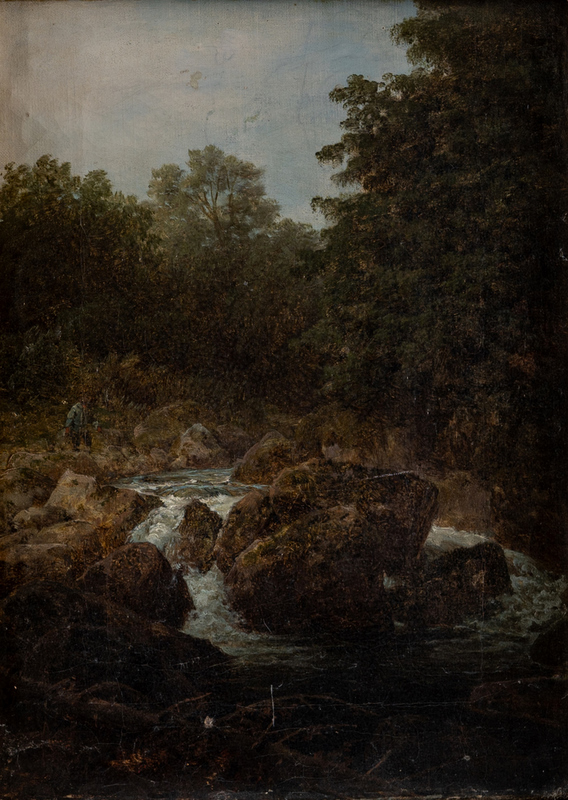
Anon.,Landscape, 19th Century, oil/canvas, 21 x 22,7 cm, MG-70
Foto: Jovan Kliska

Anon., Portrait of a Lady, Early 20th Century, oil/canvas, 160,5 x 135 cm, MG-1189
Foto: Jovan Kliska
Introduction
Ivana Rončević Elezović, Ph.D
Back to Unattributed and Undated works
Unattributed and Undated Worksin the Holdings of the National Museum of Modern Art in Zagreb
Introduction
One hundred and thirty-two unattributed and undated paintings in the holdings of the National Museum of Modern Art in Zagreb constitute a fascinating body of work, hitherto unknown to both scholars and the wider public. The works include portraits, landscapes, vedute, interiors, animal paintings, mythological and genre scenes, religious themes, still lifes, nudes, and exotic examples such as a number of woodcuts featuring Japanese motifs. The majority of these works date from the 19th and early 20th centuries, with a few likely originating earlier, probably in the 18th century. Stylistically, they include Biedermeier, Classicist, Romantic, and Realist works, as well as a number of pieces showing early 20th-century avant-garde influences.
The project, requiring a collaborative and interdisciplinary approach, was carried out by the curatorial team (Dajana Vlaisavljević and Ivana Rončević Elezović PhD, museum advisors at NMMU) together with the restoration team (Petra Kursar MA, Marija Kalmeta, and Ana Dumbović, senior conservators-restorers, and Sonja Pavin, conservator-restorer, all at NMMU), with contributions from senior photographer Jovan Kliska and IT specialist Mihovil Krušlin. Due to the specific nature of the material, the work took considerable time, and its conclusions, including estimates of dating, stylistic and iconographic analyses, provenance, and occasional new attributions or restoration findings, are presented here through the medium of a virtual exhibition.[1]
Examination of the artworks revealed, to our pleasant surprise, that many possess a high level of artistic and technical quality, characteristic of the holdings of a European city from the 19th and early 20th centuries. Old inventory books and markings on the backs of the paintings show that a number of these works came into the museum through the so-called KOMZA,[2] which operated in Zagreb from 1945 to 1954, assigning objects to museums and other institutions for safekeeping.[3] Based on the low inventory numbers, some of the unattributed works were entered directly into the museum’s Inventory Books, while others remained in the NMMU Storage Book for many years, only being transferred to the museum’s inventory through donation agreements and similar means in more recent times.[4] This body of works should be seen as a document of its time and a snapshot of Zagreb’s bourgeois cultural scene in the 19th and first half of the 20th century. The fate of this nearly forgotten and largely unknown heritage in the museum’s storerooms captured the interest of the curatorial staff, who resolved to gradually catalogue, study, and present the works to the public. The restoration of these works has proven highly complex and demanding, requiring collaboration with numerous external specialists and institutions, and cannot be completed in the short term.[5] It is therefore treated as an ongoing museum project, continuing beyond the opening of this exhibition.
The exhibition aims to study and present the artworks through detailed examination and documentation of the paintings themselves (including photographs of the entire work, details, reverse sides, and images captured using ultraviolet fluorescence [UVF]), combined with research into archival sources and scholarly literature. Since these works have generally not been exhibited before, this offers a valuable insight into the holdings of the National Museum of Modern Art in Zagreb. It also provides an opportunity for comprehensive conservation treatment. During this process, interesting discoveries relating to the paintings are likely to emerge, which will be documented and presented in separate conservation reports.
This painting corpus can be categorised into four main groups according to subject matter: portraiture, landscapes, vedute, and interiors; animal painting, and other less common subjects, including religious works, mythological scenes, still lifes, historical themes, and genre scenes. This last category also contains six Japanese woodcuts, which would require assessment by specialised experts. Their presence is particularly noteworthy in a collection of bourgeois character, reflecting the influence of Japanese art on Western painting in the second half of the 19th century, including its embrace of minimalism, the inherent two-dimensionality of the medium, and linearity.
Footnotes
[1] Attributions often proved difficult, hindered by illegible signatures, even when present, or by little-known artists about whom no biographical information can be found, even in exhaustive art lexicons such as De Gruyter’s Allgemeines Künstlerlexikon.
[2] Commission for the Collection and Protection of Cultural Monuments and Antiquities
[3] Museum documentation of the National Museum of Modern Art, Zagreb (hereafter NMMU), Inventory Book, Book I (from MG-1 to MG-2999), 1–280; NMMU Museum Documentation, Inventory Book, Book II (from MG-3000 to MG-6937), 1973, 1–520.
[4] The Storage Book lists works that are not the property of the museum but have been entrusted to it for safekeeping, scholarly study, presentation, and management.
[5] The collaboration has also resulted in the preparation of professional expert reports, for example:
Kali Radojlović, Conservation-Restoration Treatments of the Painting “Woman in the Kitchen” from the National Museum of Modern Art, Zagreb (Master’s Thesis). Zagreb: University of Zagreb, Academy of Fine Arts (2024), pp. 1–122. Available at: https://urn.nsk.hr/urn:nbn:hr:215:555042; Iva Galijan, Conservation- Restoration Treatments of the Easel Painting “Woman in a Blue Dress”, by an Unknown Artist, from the National Museum of Modern Art, Zagreb (Master’s Thesis). Zagreb: University of Zagreb, Academy of Fine Arts (2024). Available at: https://urn.nsk.hr/urn:nbn:hr:215:768649