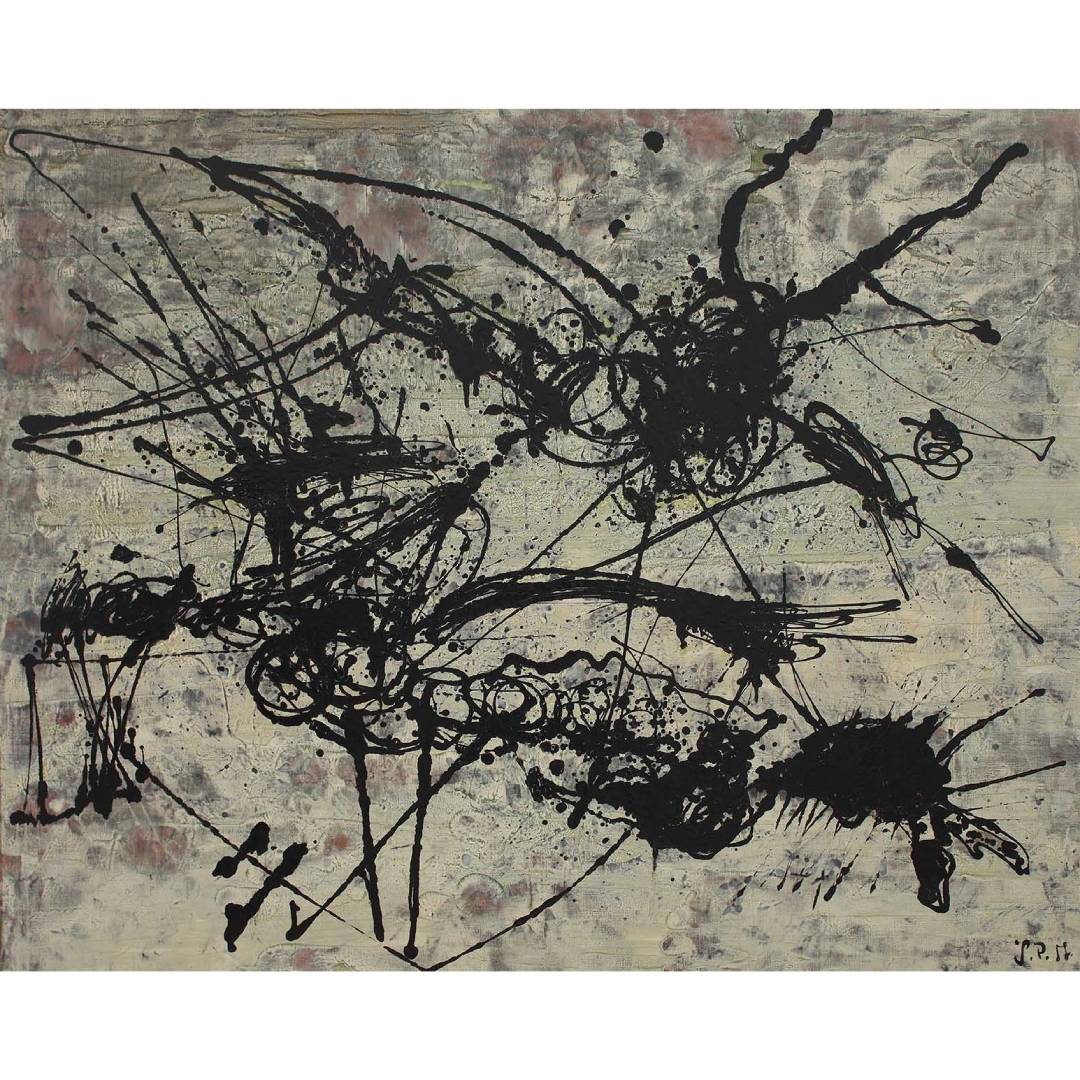
Šime Perić, Novella, 1958

Šime Perić
Novella, 1958
oil on canvas
130 × 162 cm
MG-4794

Šime Perić (1926–1990) studied mural painting at the École des Beaux-Arts in Paris and graduated from the Academy of Applied Arts in Belgrade in 1952. He emerged in the post-war period with works rooted in intimist figuration and dense chromatic structuring. Initially associated with socially engaged painting through Krsto Hegedušić’s circle, Perić rapidly shifted toward an autonomous exploration of colour, surface, and rhythm. By the late 1950s, his painting began to loosen figural definition in favour of expressive chromatic fields and symbolic reduction.
In Novella, Perić abandons intimist figuration and constructs a painting dominated by gestural eruption and material density. The surface is structured through vigorous black linear networks that traverse the canvas in sweeping arcs, splatters and concentrated knots of pigment. Rather than defining stable forms, the lines accumulate into agitated clusters that suggest movement, collision and compression. The pale, textured ground remains visible beneath the dark calligraphic layers, creating a tension between depth and surface. Spatial illusion is rejected; the painting asserts itself as a field of action in which gesture, gravity and material interaction determine the composition. Within the broader exhibition narrative, Novella reflects the emergence of material and gestural experimentation in post-war Croatian painting.
Text: Marta Radman, curator at the National Museum of Modern Art, Zagreb

Translated by: Marta Radman © National Museum of Modern Art, Zagreb
Photo: Goran Vranić © National Museum of Modern Art, Zagreb
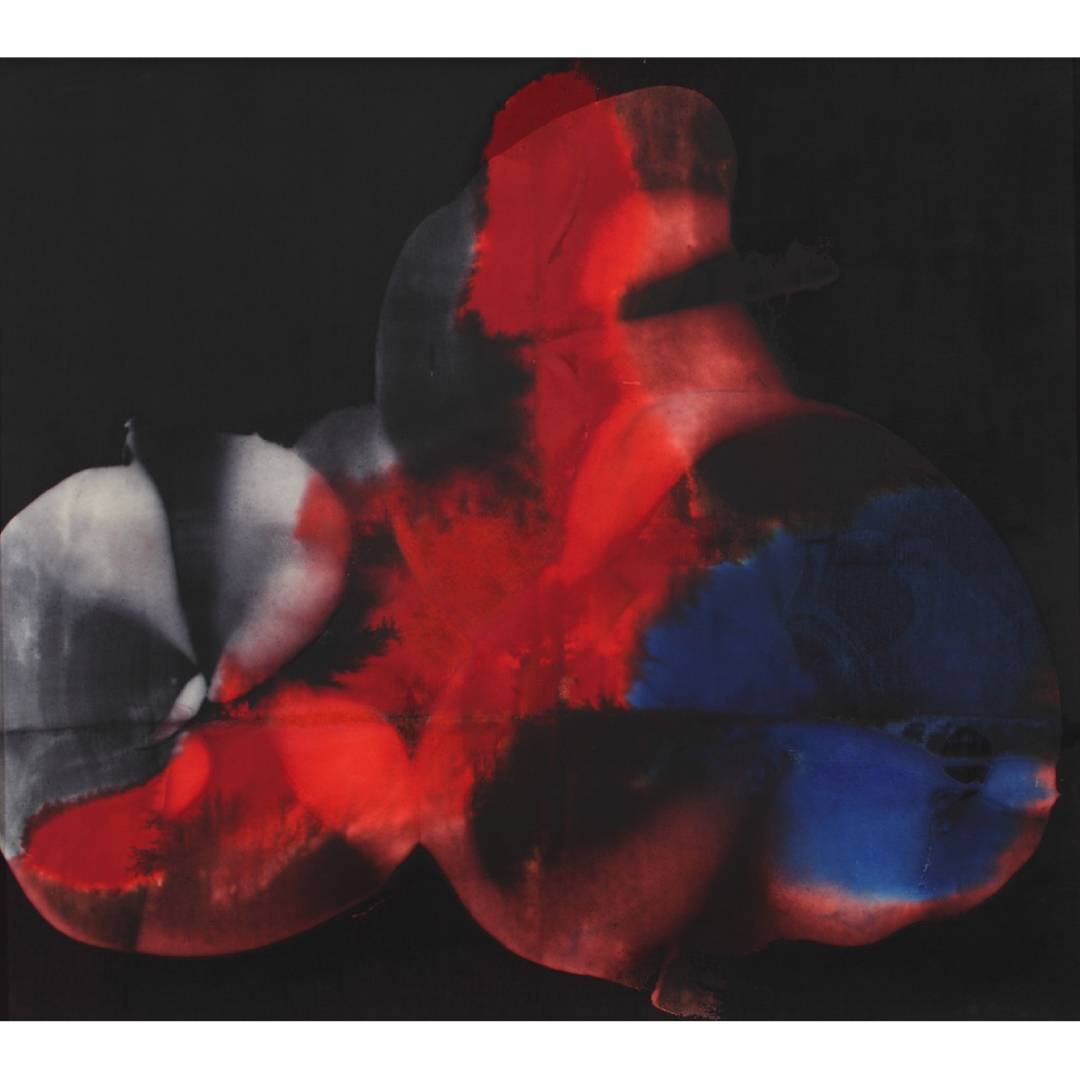
Šime Perić, Movement, 1969

Šime Perić
Movement, 1969
oil on canvas, 120 × 135 cm
MG-4502

Šime Perić (1920–2019) was a figurative-abstract fantasist and a classic of Croatian painting. In the 1950s, his oeuvre विकसित from impressionistic, coloristic figuration toward abstraction grounded in action painting and Tachism. Following the dark, painterly Informel phase of the 1960s, the 1970s saw him create works of refined yet intense chromatic expression. By abandoning the rectangular format of the canvas, he occasionally produced paintings in the form of a tondo, invoking through the circular form the archetypal image of the island. From the 1980s onward, he also worked successfully in sculpture.
A semester spent in Paris in 1949 was crucial for his artistic development and intellectual expansion. He studied fresco painting at the École des Beaux-Arts in Paris. He graduated from the Academy of Applied Arts in Belgrade in 1952 and was an associate of the Master Workshop of Krsto Hegedušić until 1957. At the Academy of Fine Arts in Zagreb, he was a professor from 1969 to 1984.
The stain and its transformation into chromatic centrifugal and centripetal movements constitute one of the foundations of Perić’s oeuvre. Movement (1969) is both a chronological and morphological marker of abstract colorism. It is articulated through the gradation of clusters and the formation of a distinctive colored translucency. The work stands at the intersection of physical materiality and a chromatic symphony that absorbs and radiates in all directions, forming a kind of colored amalgam—an amorphous yet shaped core of everything. This color symphony is marked by pronounced elegance and delicacy, with a dispersed, glowing, and in parts absorbing expression achieved against a black ground.
Šime Perić received the “Vladimir Nazor” Lifetime Achievement Award in 1989. In 2003, a monograph on Perić by T. Maroević and M. Šolman was published. In 2007, based on Perić’s designs, the 12th section of the “White Road” was realized in Dubova Park near Labin.

Text: Željko Marciuš, Museum Advisor at the National Museum of Modern Art © National Museum of Modern Art, Zagreb
Photo: Goran Vranić © National Museum of Modern Art, Zagreb

Šime Perić, Sculpture I, 1986

Šime Perić
(1920 – 2019)
Sculpture I, 1986
wood; stain
72 x 43 x 34.5 cm
MG-8416

Šime Perić is considered one of the significant figures of Croatian modern and contemporary art, with a body of work that demonstrates exceptional diversity and expressive depth. He began his artistic education at the Academy of Applied Arts in Belgrade, graduating in 1952 under Professor Vasa Pomorišac. In 1949, during his studies, he spent a semester at the prestigious École nationale supérieure des Beaux-Arts in Paris, where he focused on the study of fresco painting. These early experiences shaped his technical precision and spatial sensitivity, both of which would later strongly influence his sculptural practice.
After several years devoted to copying frescoes, Perić entered a prolific phase through his collaboration with the Master Workshop of Professor Krsto Hegedušić between 1952 and 1957. In 1957, he became a member of the Mart Group and later joined Gallery Forum in Zagreb in 1969, securing his place within the Croatian art scene. At the same time, he shared his artistic passion with younger generations as a professor at the Academy of Fine Arts in Zagreb, where he taught from 1969 to 1984, advancing from assistant professor to full professor.
What sets Perić apart from his contemporaries is his consistent pursuit of spatial structuring of dynamic forces within his paintings, alongside an exploration of formal possibilities in sculpture. Unlike his vividly chromatic paintings, his sculptural works are crafted from natural materials such as untreated, steamed, and bent wood. These sculptures are marked by reduced forms, masterful craftsmanship, and a clarity in the rhythmic organization of space.
A notable example is his Sculpture I from 1986, which embodies Perić’s ability to fuse restraint with movement. The piece features two highly polished, fluid forms that rise sinuously from a rectangular base, defying gravity and evoking a sense of elastic, organic energy. Through this work, Perić demonstrates how abstract painting can find its extension in sculpture, turning space itself into an active participant in artistic expression.
The mentioned sculpture by Šime Perić is currently on display as part of the exhibition "Contrasts" from the NMMU On Tour cycle at the City Museum of Nova Gradiška.
Text: Tatijana Gareljić, Museum Advisor, National Museum of Modern Art © National Museum of Modern Art, Zagreb
Photo: Goran Vranić © National Museum of Modern Art, Zagreb

Šime Perić, Composition IV, 1961

Šime Perić
(1920-2019)
Composition IV, 1961
oil on hardboard, 170x122 cm
170 x 122 cm
MG-4500

Šime Perić (1920-2019) was a figurative-abstract fantasist and a classic of Croatian painting. During the 1950s, his works developed from impressionistic colouristic figuration into gesture- and Tachisme-based abstraction. After his darkish Art Informel period during the 1960s, in the 1970s he produced paintings of refined yet colouristically intense expression. He started abandoning quadrangular canvases and sometimes painted tondos, whose circular form evokes the archetypal image of an island. In the 1980s he began sculpting as well, and successfully so. In 1949 he spent a semester studying fresco painting in Paris at the National School of Fine Arts, which turned out to be of crucial importance for Perić’s painting and expanded his horizons intellectually. He graduated from the Academy of Applied Arts in Belgrade in 1952 and worked as an associate at painter Krsto Hegedušić’s master workshop until 1957. He taught at the Academy of Fine Arts in Zagreb between 1969 and 1984.
The motif of stain and its transformation into colouristic centrifugal and centripetal motion is one of the bedrocks of Perić’s oeuvre. His Composition IV painting from 1961 defines Art Informel in Croatia both chronologically and morphologically. The painting is executed by grading clusters of formless, magma-like matter. It lies at the crossroads of factuality, the physical materiality of painting and the feelings of restlessness and existential angst it expresses.
Šime Perić is the recipient of the 1989 Vladimir Nazor Lifetime Achievement Award given yearly by Croatia’s Ministry of Culture. In 2003 Perić’s monograph was authored by art historians Tonko Maroević and Mladenka Šolman. In 2007, the 12th leg of the White Road in the Dubrova Sculpture Park near the town of Labin in Istria was built based on Perić’s designs.

Text: Željko Marciuš, museum consultant of the National Museum of Modern Art © National Museum of Modern Art, Zagreb
Translated by: Ana Janković
Photo: Goran Vranić © National Museum of Modern Art, Zagreb